How to Raise or Lower GH, KH, and pH in Your Aquarium (Without Making Things Worse)
The Tank Guide · A FishKeepingLifeCo publication — Aug 2026
If you've decided your water genuinely needs to change — not just drift a little from a care sheet, but actually needs adjusting for a specific reason — the next question is how to do it without creating a new problem in the process.
(If you're still working out whether an adjustment is the right call in the first place, our guide to what GH, KH, and pH actually mean covers that decision in more depth. This article picks up from there: you know what you're trying to change, and you want to do it in a way that actually holds.)
The short version is that different methods change different things. Something that raises KH won't necessarily touch GH. Something that raises GH won't necessarily do anything to your buffering. And a lot of the products marketed to change pH directly don't hold up well against water that's already buffered against exactly that kind of change. Knowing which lever moves which parameter is most of what separates an adjustment that sticks from one you end up repeating every week.
Test Before You Adjust Anything
Test your tank's GH, KH, and pH before changing anything — and test your source water (tap, well, or RO) for the same three.
Your source water is what you'll be working with, or against, every time you do a water change. If your tap water already sits reasonably close to where you're trying to go, the simplest path is often adjusting the water you add rather than repeatedly dosing the tank itself. If it's working against you, that's worth knowing before you start.
Prepare the Water — Don't Just Correct the Tank
Whenever it's practical, adjusting the chemistry of the water before it goes into the tank — blending, remineralizing, or dosing a change-water batch ahead of time — tends to work better than repeatedly correcting an established tank with direct doses. Preparing water ahead of time gives you something consistent and repeatable. Reacting to today's reading with another dose tends to produce exactly the kind of back-and-forth this guide is trying to help you avoid.
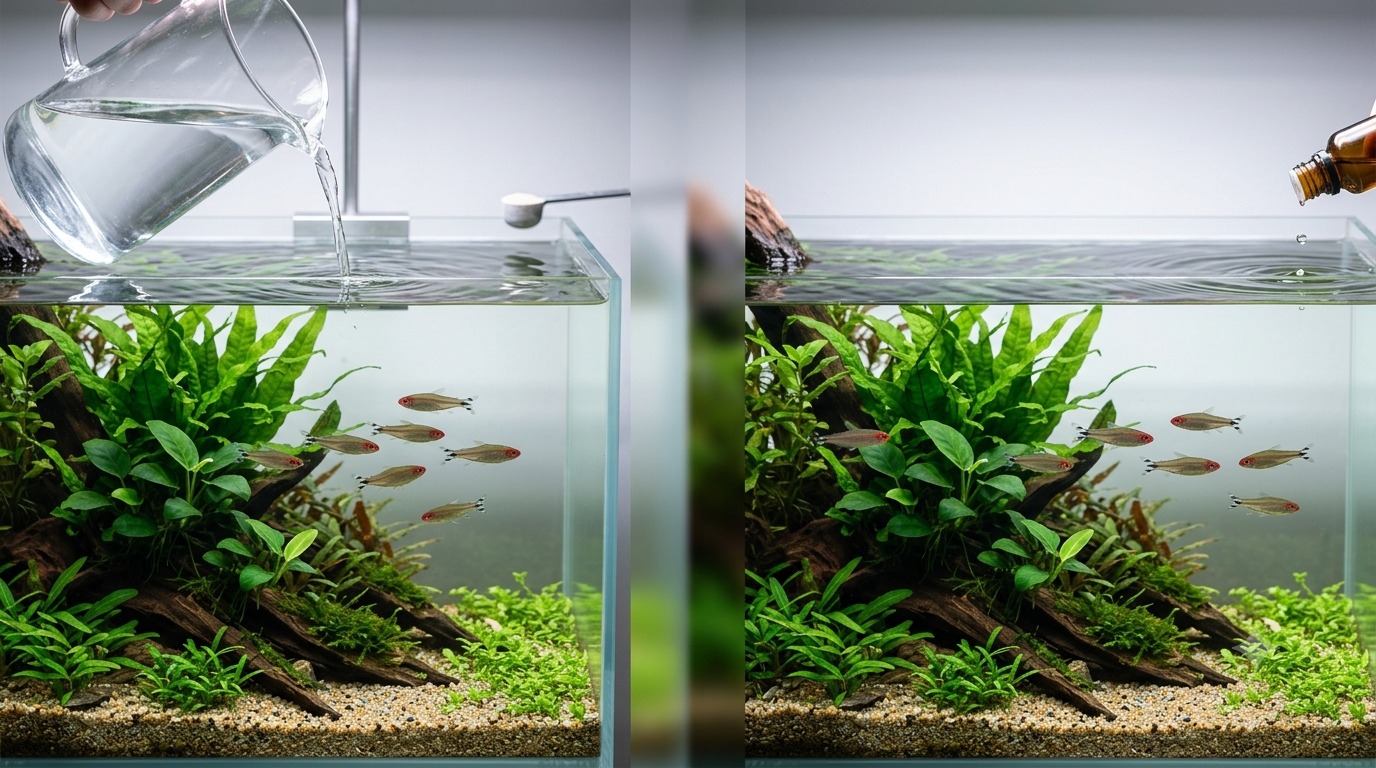
That doesn't mean nothing should ever go directly into a tank. Some slow-acting methods, like crushed coral sitting in a filter bag, work precisely because they're part of the system continuously. But for anything you're dosing on purpose, preparing it in the water you're about to add is usually the more controlled path — and it's a theme worth keeping in mind through each of the methods below.
Raising GH
GH goes up when calcium and magnesium are added to the water — through soluble mineral salts, a slowly dissolving mineral like crushed coral, or a remineralizing product built for the job.
| Method | What It Does | Speed | Worth Knowing |
|---|---|---|---|
| GH-only remineralizer | Raises GH; no effect on KH | Immediate | A common choice when you need minerals without adding buffering — shrimp keepers on RO water rely on this. Dose by weight rather than by scoop for consistency between batches. |
| Calcium and magnesium salts (e.g., calcium sulfate, magnesium sulfate) | Raises GH; no effect on KH | Immediate to same-day | The DIY version of a GH-only remineralizer. Aim for a reasonable balance of both rather than dosing calcium alone — magnesium matters too, and it's easy to overlook. |
| Crushed coral / aragonite | Raises GH and KH together | Slow — days to weeks | Covered in its own section below. Effectiveness depends heavily on your existing water chemistry. |
Raise GH gradually rather than all at once, especially if you're keeping shrimp or snails — they tend to be more sensitive to fast mineral swings than most fish. Dosing into the water you're about to add during a water change, rather than straight into an established tank, gives you a more controlled, repeatable process than dumping product into the display.
(If you're adjusting GH specifically for shrimp or snails, see which species actually need more mineral availability before deciding how far to push it.)
Lowering GH
For most aquarium keepers, the most practical and predictable way to lower GH is dilution with low-mineral water — RO water, distilled water, or, with some caveats around collection, rainwater.
A few methods that seem like they should work usually don't hold up. Household water softeners typically swap calcium and magnesium for sodium rather than removing hardness outright — GH drops, but KH and total dissolved solids stay put, and softened tap water usually isn't a good substitute for genuinely soft water in an aquarium. Boiling only removes the portion of hardness tied to bicarbonate, leaves the rest untouched, and isn't practical at aquarium scale regardless. Chemical "water softener" products marketed for aquariums often bind calcium rather than remove it, which can make a GH reading drop without meaningfully changing what's actually in the water.
If GH needs to come down and stay down, blending tap water with RO water — or switching to RO with deliberate remineralization afterward — is the more dependable route.
Raising KH
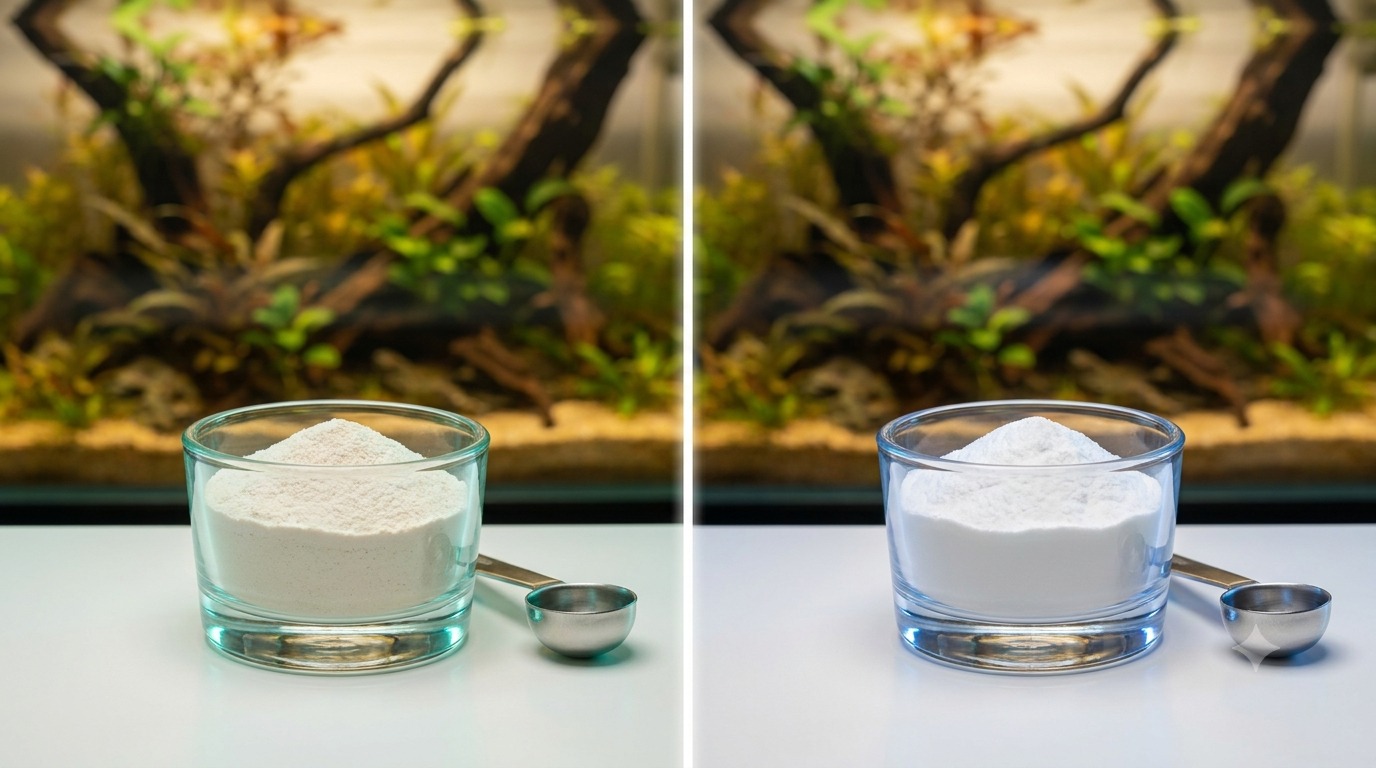
KH goes up when a carbonate or bicarbonate source is added — most directly with baking soda, or more gradually through a dissolving mineral like crushed coral.
| Method | What It Does | Speed | Worth Knowing |
|---|---|---|---|
| Baking soda (sodium bicarbonate) | Raises KH; no effect on GH | Immediate | Precise and easy to control. Adds sodium, so it's not the right choice if you're specifically trying to avoid that. |
| Potassium bicarbonate | Raises KH; no effect on GH | Immediate | Functions like baking soda, but adds potassium instead of sodium — a nutrient plants can actually use. |
| Crushed coral / aragonite | Raises GH and KH together | Slow | Same dissolving mechanism described below. |
| Commercial buffer products | Depends on the product | Immediate | Not all "buffers" change the same thing — check the label for which parameters it's actually designed to affect rather than assuming. |
As with GH, this works best applied to the water you're about to add rather than dosed straight into an established tank — it's a more predictable way to get a consistent result. Add gradually here too, particularly in a tank that's already stocked — and it's worth pausing on one specific caution: raising KH also tends to raise pH, and if there's any ammonia present in the water — an overdue water change, a recent overfeeding, a young or struggling filter — a fast pH rise makes that ammonia considerably more toxic almost immediately. If there's any doubt, test ammonia first and make the change gradually rather than all at once.
Lowering KH
As with GH, the most practical way to lower KH for most keepers is the same: dilution with RO water or another low-mineral source.
It's worth understanding why acid-based products often disappoint here. Adding acid directly to water that still has meaningful KH tends to get absorbed by that buffering with little visible effect on the reading. Repeating the dose doesn't lower pH so much as quietly use up the buffering a little at a time — until it's low enough that an ordinary-sized dose produces a much bigger change than any of the doses before it. Reducing KH by dilution first, and only then addressing pH if it's still not where you want it, is a more predictable sequence than trying to out-dose the buffering directly.
Active aquasoil works differently from inert gravel or sand. An inert substrate just sits there; an active soil is built to interact with the water around it, and many are specifically designed to draw KH down and help hold a softer, more acidic environment — largely through ion exchange between the soil and the water rather than through anything you dose by hand.
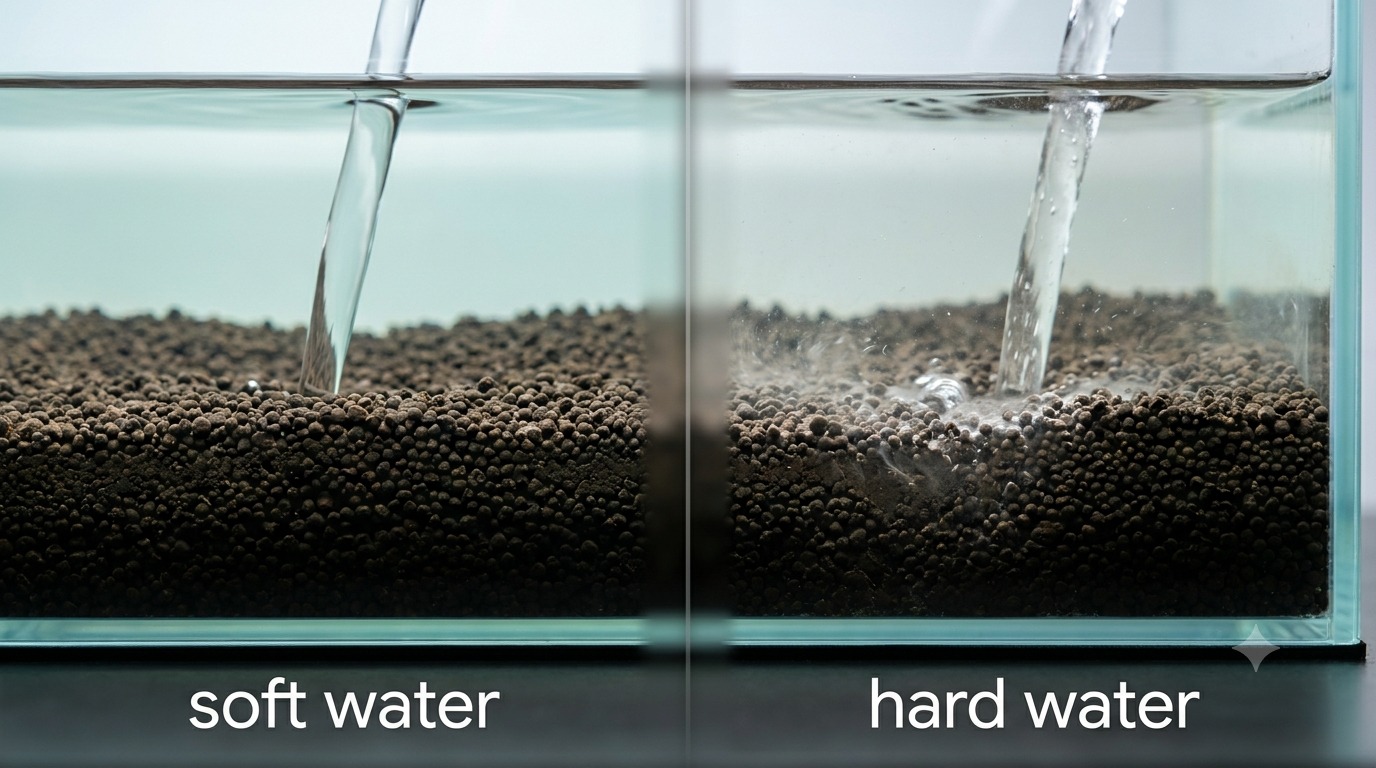
That's also why these substrates are usually paired with soft or RO source water rather than hard tap water. If the water going into the tank is already low in KH, the substrate isn't working against much incoming buffering with each change. Paired with hard, high-KH tap water instead, every water change reintroduces a meaningful amount of carbonate buffering that the substrate then has to work through again — which can show up as KH and pH ticking upward right after a water change, then drifting back down over the following days as the substrate reasserts itself. The system as a whole becomes harder to predict, and it works against the exact chemistry the substrate was chosen to create in the first place.
How long an active substrate keeps this up varies considerably — it depends on the specific product, how hard the source water is, and how the tank is maintained, so there's no fixed timeline to expect. What's consistent is the general pattern: the closer the replacement water is to what the substrate is trying to hold, the less work it has to do, and the more predictable the results tend to be.
Raising or Lowering pH Directly
pH usually isn't something worth adjusting on its own. It moves in response to GH, KH, and whatever acids — CO2 included — are already present in the water, so a lasting pH change comes from adjusting one of those, not from a product that targets pH by itself.
| If your goal is… | The more durable approach is… |
|---|---|
| A higher, more stable pH | Raise KH (baking soda, crushed coral) |
| A lower pH | Lower KH first through dilution, then let a mild, ongoing source — aquasoil, driftwood, botanicals — hold it there |
| A precise pH for a CO2-injected planted tank | A different situation entirely — CO2 injection lowers pH without touching KH or GH, and is managed on its own terms |
Commercial pH-up and pH-down products can move a reading in the short term, but in water with meaningful KH, that effect is often temporary and needs repeating — see the mechanism above for why.
A Note on Crushed Coral
Crushed coral and aragonite raise GH and KH together as they dissolve, and generally help support a higher, more stable pH — but how much they do, and how fast, depends on your water.
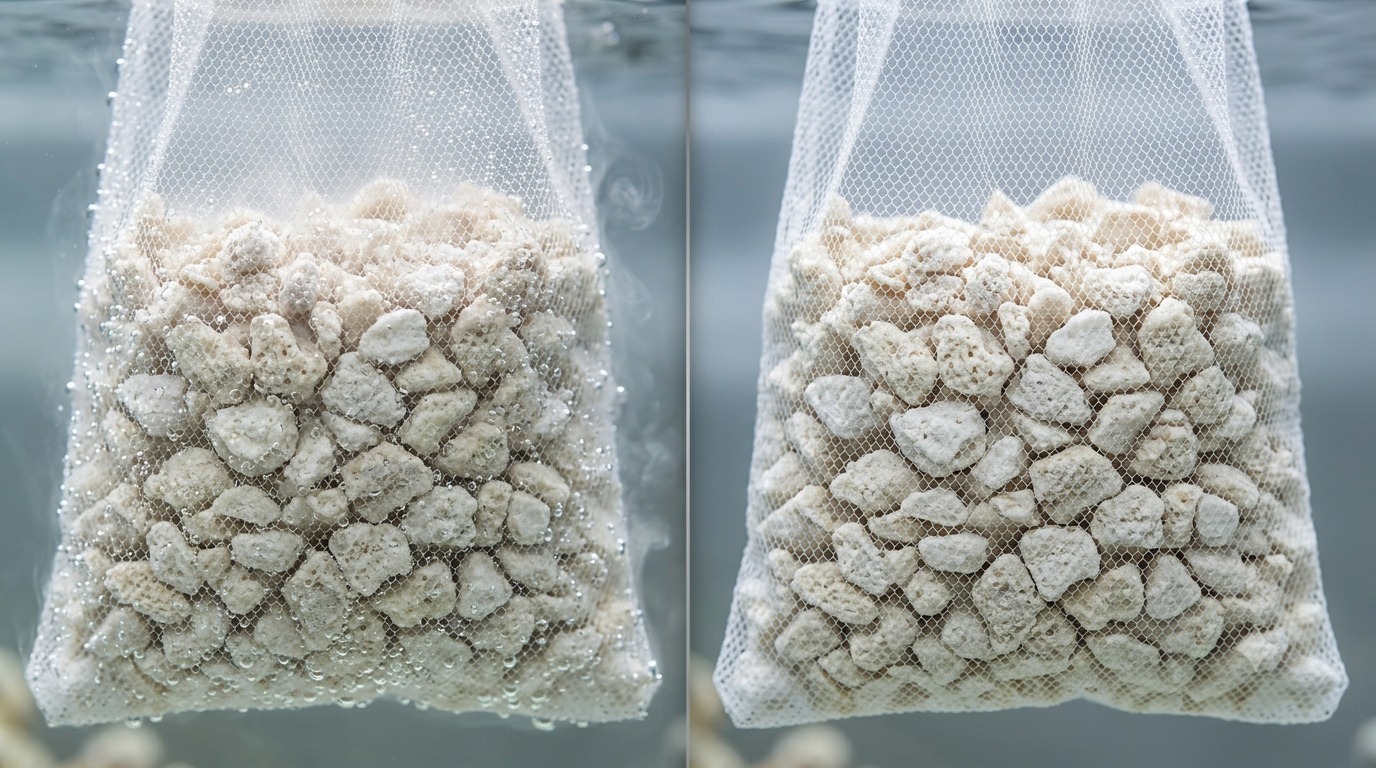
They dissolve faster in soft, more acidic water and slow down considerably as water gets harder and more alkaline. In water that's already fairly hard, crushed coral may barely dissolve at all — which is usually the explanation the next time you add some and don't see much change, rather than a sign it's not working. It isn't something with a guaranteed stopping point at "the right" numbers, so it's worth testing periodically rather than assuming it'll settle wherever you happen to need it.
Placement matters for how much control you keep. A media bag in the filter is removable and adjustable — you can add more, take some out, or pull it entirely if you change your mind. Mixed into the substrate, it's effectively permanent, especially once a tank is established and planted.
RO Water and Remineralization
RO water contains very little mineral content or buffering capacity — essentially none of the calcium, magnesium, or alkalinity that were in the source water before it went through the membrane. When RO is being used as the primary water source for a tank, it generally needs to be remineralized, or blended with tap water, to build back the GH, KH, and overall chemistry appropriate for whatever you're keeping.
Which approach makes more sense depends on the goal. Blending RO with tap water is a straightforward way to dilute an otherwise too-hard or too-alkaline supply while keeping some of its natural mineral content — and it ties back to the same principle as above, since blending is really just another form of preparing water before it goes in. Remineralizing RO from scratch gives you more independent control over the specific GH and KH you end up with, rather than being tied to whatever ratio your tap water happens to provide.
Which remineralizer makes sense depends on what you're keeping. A GH-only product adds minerals without buffering — the standard approach for shrimp that need calcium and magnesium but also need low KH to keep pH acidic. A combined GH/KH product raises both together and is the more general-purpose choice for community tanks built on RO.
However you're remineralizing, mix and dose into a separate container rather than directly into the tank, and dose by weight rather than by scoop — scoops compact and settle differently between fills, which makes them a surprisingly common source of inconsistency.
A TDS meter is a useful tool here, but it's worth being clear about what it actually tells you. TDS is a conductivity-based estimate of everything dissolved in the water — it doesn't distinguish calcium and magnesium from anything else, and it can't tell you whether your GH and KH are actually where you want them. Its real value shows up once you've already worked out a remineralization recipe: test a properly mixed batch for GH and KH, note what TDS that batch reads, and from then on you can use TDS as a quick check that later batches were mixed the same way — not as a substitute for testing GH and KH directly.
Keeping Changes Controlled
A few habits make the difference between an adjustment that works and one that turns into an ongoing project:
- Prepare replacement water rather than correcting the tank directly, whenever that's practical. A blended, remineralized, or pre-dosed batch of change water gives you a predictable result. Reacting to today's tank reading with another dose tends to create the back-and-forth this whole approach is trying to avoid.
- Change one thing at a time. Stacking methods — crushed coral and aquasoil, baking soda and a commercial buffer — makes it hard to know what's actually doing what, and some combinations work against each other rather than together.
- Go gradually, especially in a stocked tank — but gradual doesn't mean constant small doses. A controlled transition is usually easier to manage through a series of properly prepared water changes than through repeated tiny corrections to the tank in between. The goal is a predictable move toward the new chemistry, not an ongoing chase of the number.
- Give slow methods real time. Crushed coral and aquasoil work over days to weeks, not hours. Test, wait, and test again before deciding whether something is or isn't working.
- Check ammonia before raising KH or pH quickly, particularly in a tank that's been neglected or recently overfed.
Frequently Asked Questions
How long does it take for crushed coral to raise KH?
Usually days to a couple of weeks before you'll see a meaningful change on a test kit, and the pace depends on your water's existing chemistry, how much you're using, and how much flow passes over it.
Does baking soda raise GH?
No. Baking soda raises KH specifically and doesn't add any calcium or magnesium.
Why isn't my pH dropping even though I added a pH-down product?
Most likely because your KH is absorbing it. In water with meaningful buffering, acid additives tend to get consumed by that reserve rather than producing a lasting pH change — repeating the dose usually drains the buffering rather than fixing the pH.
Can I use tap water instead of a commercial product to remineralize RO water?
Sometimes, if your tap water's GH and KH are reasonably close to what you're aiming for — blending tap into RO is a legitimate way to remineralize. It won't give you independent control over GH and KH the way a dedicated remineralizer will, since blending preserves your tap water's existing ratio between the two.
Do I need to remineralize RO water for every water change?
Yes. RO water starts with very little dissolved in it, so it needs the same remineralization treatment every time it's used, not just when the tank is first set up.
Is it safe to use crushed coral and aquasoil together?
They work against each other rather than together — the coral supplies buffering, the soil consumes it, and both get used up faster without accomplishing much. It's generally better to choose one approach based on what you're actually trying to do with your pH.
My GH went up after adding crushed coral, but my pH barely moved. Why?
That can happen, particularly if your KH was already reasonably healthy — the coral is still dissolving and adding calcium, but your existing buffering may already have been holding pH close to where it's settling now. Check KH alongside pH rather than pH on its own.
How much should I raise GH or KH at once?
Smaller adjustments made across a few water changes are generally easier on a stocked tank than one large dose all at once. That doesn't mean dosing something every single day — a controlled series of prepared water changes over a week or two is usually enough to get there predictably, without turning it into a daily task.
Adjusting GH, KH, or pH works best as a deliberate, gradual process aimed at your source water — not a reactive one aimed at whatever the tank reads today. Know what you're changing, know what method actually changes it, and give it time to work before deciding whether it did.
We talk through real examples of adjusting — and not adjusting — aquarium water on this episode of Tank Guide Life, a product of FishKeepingLifeCo: Aquarium GH, KH & pH | When to Adjust Your Water (and When to Leave It Alone). Give it a listen on Spotify or wherever you get your podcasts.

Track water parameters, maintenance, and tank changes with our journals and guides.