GH, KH & pH in Your Aquarium: What They Actually Tell You
The Tank Guide · A FishKeepingLifeCo publication — Aug 2026
GH, KH, and pH are three water parameters that cause a lot of confusion for aquarium keepers. They're often talked about together, which can make it seem like they're measuring the same thing — or that changing one will automatically change the others. Neither is true. Each one is telling you something different about your water, and confusing them — or assuming that fixing one automatically fixes the others — is where a lot of unnecessary dosing, unnecessary worry, and unnecessary tank instability comes from.
This isn't an argument for ignoring your test results. It's an argument for understanding what each number is actually telling you before deciding whether it needs your attention at all.
What Does GH Actually Tell You?
GH — general hardness — measures the amount of dissolved calcium and magnesium in your water. It's worth being precise here: GH reflects calcium and magnesium hardness specifically, not mineral content in general. Plenty of other dissolved substances — sodium, nitrate, dissolved organics — show up in a TDS reading without registering on a GH test at all, which is part of why those two numbers can tell very different stories about the same water.
Calcium and magnesium matter because fish are constantly balancing the minerals and salts inside their bodies against the water around them, and their gills are part of that process, helping regulate what moves in and out. Appropriate levels vary by species — a fish that evolved in mineral-poor water and one that evolved in mineral-rich water aren't managing quite the same balancing act, which is part of why GH needs aren't identical across species.
For shrimp and snails, mineral availability tends to matter more visibly. Calcium and other minerals support healthy molting and exoskeleton development in shrimp, and shell growth in snails, alongside diet — GH isn't the only factor, but it's a meaningful one, and water that's low in GH can leave shrimp and snails with less calcium available to work with than they need.
GH is not pH, and it's not KH, and — as the TDS point above shows — it's not simply another name for total dissolved solids either. A tank can have plenty of calcium and magnesium and still swing in pH, or carry very little mineral content and sit at a completely stable pH. The three don't move together the way it's easy to assume.
What Does KH Actually Tell You?
KH — carbonate hardness, also called alkalinity — measures your water's capacity to resist a drop in pH when acid is introduced. Despite the name, it isn't a hardness measurement in the calcium-and-magnesium sense at all.
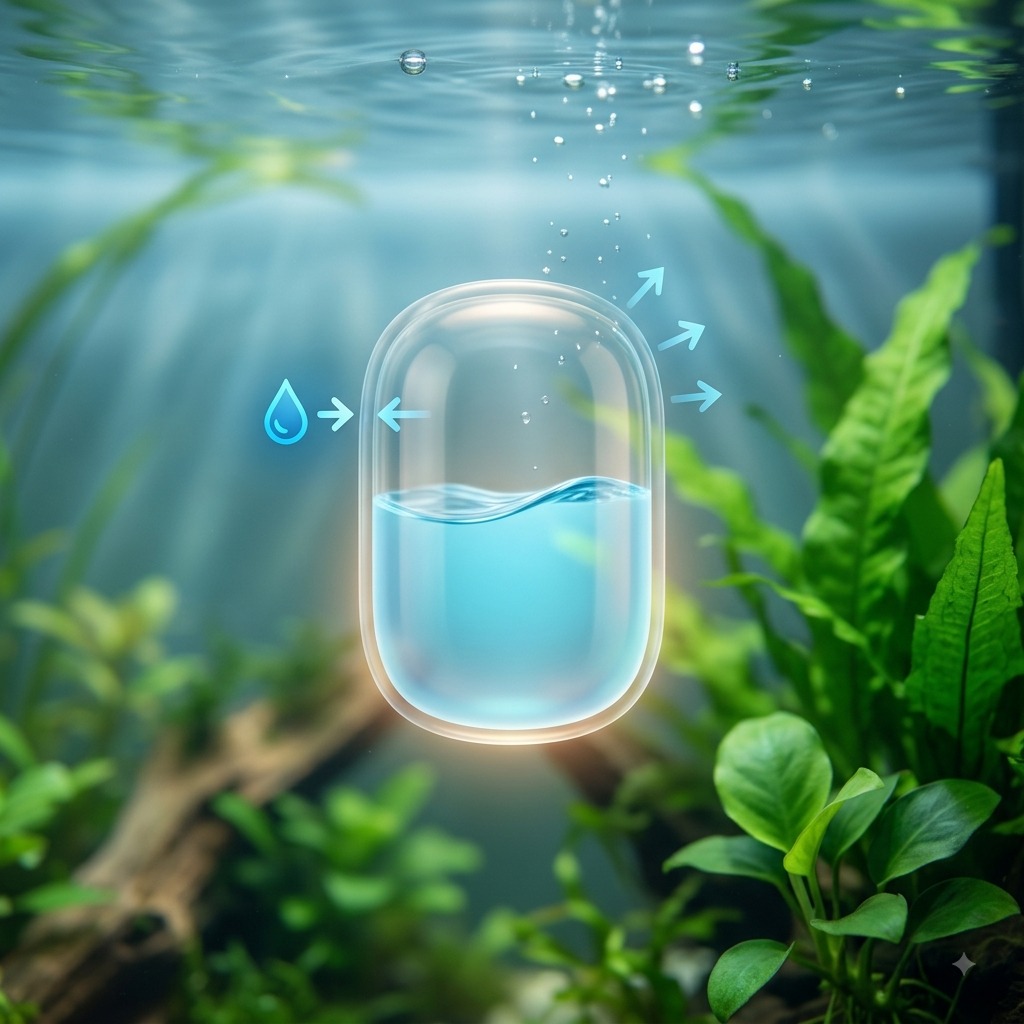
It works as a reserve. A running aquarium produces acid more or less constantly, mostly as a byproduct of the nitrogen cycle, and that acid gets absorbed by the KH reserve instead of immediately showing up as a falling pH reading. Higher KH means more of that reserve on hand, which makes pH more resistant to change — but it isn't a lock that holds pH in place forever. It's a supply that gets used up over time and needs to be replenished, either through water changes or a mineral source that slowly dissolves.
This is also why KH is the parameter most connected to pH stability. As it runs low, the water has less capacity left to absorb whatever acid shows up next, so pH becomes freer to move. But low KH by itself isn't a crisis. Blackwater tanks and soft-water shrimp setups are run successfully at very low KH for years — on purpose — by keepers who maintain them with that in mind: consistent water changes, appropriate source water, and a bioload that doesn't outpace what little buffering is there. Low KH changes what kind of attention a tank needs. It doesn't automatically mean the tank is unhealthy.
What Does pH Actually Tell You?
pH tells you how acidic or basic your water is right now. It says nothing on its own about how much mineral is in the water, and nothing about how resistant that water is to changing.
It's a common shortcut to assume a high pH reading means hard water, or a low reading means soft water. Neither holds up reliably. Household water softeners are a clean example: they strip calcium and magnesium out of the water — lowering GH — while leaving alkalinity completely untouched, so the water can test soft while sitting at a stubborn, well-buffered high pH. The reverse shows up too. A heavily stocked tank that's gone a long time without adequate water changes can be quite hard by GH and still show a pH that's slowly drifting down, because the buffering that would normally hold that pH steady has been gradually consumed. High GH and falling pH, at the same time, in the same tank — a good illustration of why pH alone can't tell you whether water is hard or soft.
It also means two aquariums can read the exact same pH and have almost nothing else in common. One might be soft and barely buffered, ready to move the moment something in the tank changes. The other might be hard and heavily buffered, much more resistant to whatever acid shows up next. Same number on the test kit, completely different situation underneath it.
How Do GH, KH & pH Work Together?
None of the three can be reliably predicted from either of the other two.
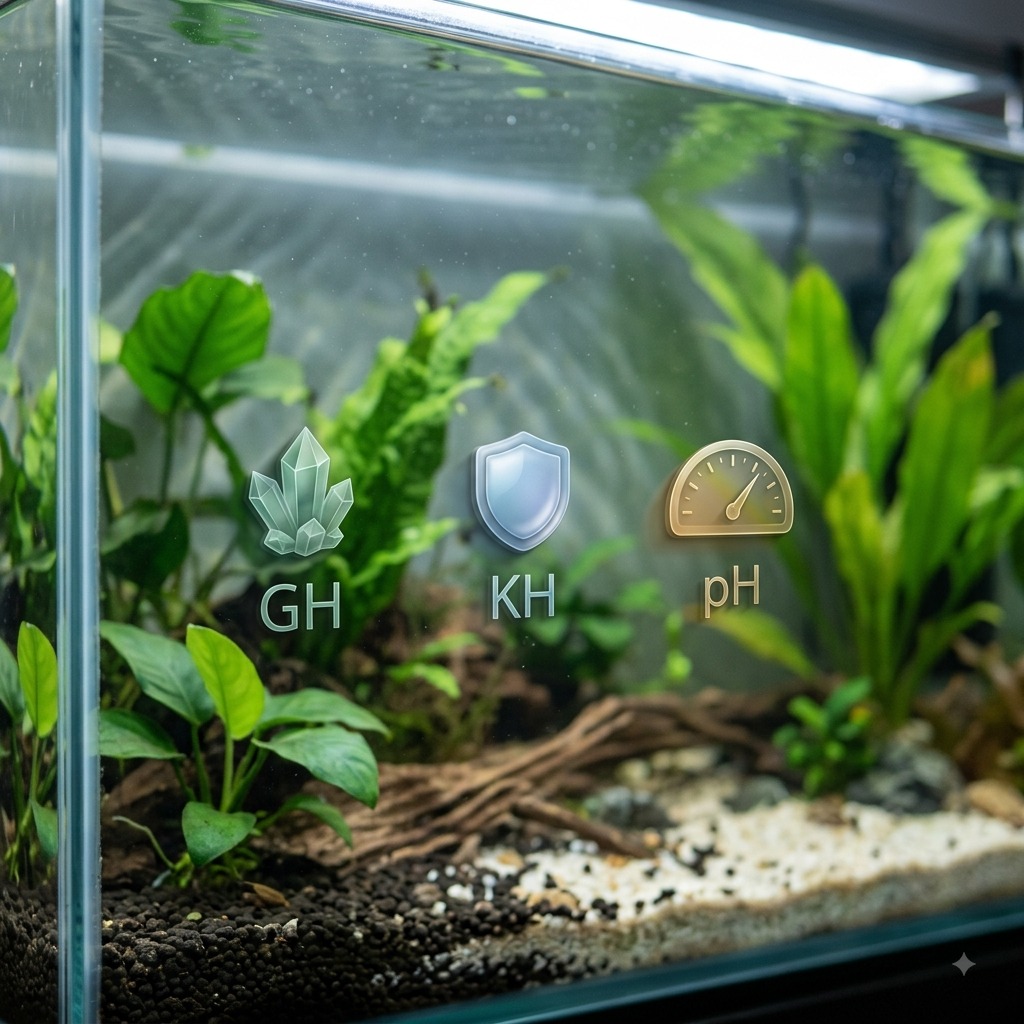
| Parameter | What It Tells You | What It Doesn't Tell You |
|---|---|---|
| GH | How much calcium and magnesium is dissolved in the water | Your pH, or how resistant the water is to pH changes |
| KH | How much buffering capacity the water has against pH swings | How much overall mineral (calcium/magnesium) is present |
| pH | How acidic or basic the water is right now | Whether the water is hard or soft, or how stable it is |
Testing all three gives you a far clearer picture of what's actually going on in a tank than testing just one and assuming the rest. Hard water and alkaline water do tend to travel together in nature, so a single reading is sometimes a reasonable guess about the others — but it's still a guess, and it's the exceptions to that general tendency — soft water that's heavily buffered, hard water that isn't buffered at all — that cause most of the confusion people run into with their water chemistry.
For a deeper look at exactly how GH and KH can pull apart — and what that looks like in real tap water — see our full guide: How to Safely Raise or Lower Aquarium GH, KH, and pH.
Why Isn't There One Perfect Set of Aquarium Parameters?
There isn't a universal ideal for GH, KH, or pH because the right answer depends on what's actually living in the tank — where that species' ancestors came from, whether the individual fish in front of you were bred in captivity or caught wild, and what you're actually trying to accomplish.
Here's the situation a lot of aquarium keepers run into: your fish's care sheet recommends a pH of 6.5, and your tap water comes out at 7.6. What now?
Start by asking where that number on the care sheet actually came from. Published ranges get built from a mix of sources — wild habitat surveys, a breeder's personal notes, one keeper's own tank, or simply copied from another website — and most sites never tell you which. A range built from where a species is collected in the wild describes something very different from a range built around how that same species is actually raised on a farm before it ever reaches a store.
Then ask what you're trying to do with the fish. Captive-bred fish can sometimes tolerate a wider range of water than the wild population their species descended from — but that's not automatic or universal. It depends on the conditions they were actually raised in, selective breeding within that particular strain, how well they've been acclimated, general husbandry, and real differences between captive lines even within the same species. Some captive-bred fish handle a wide range comfortably; others are pickier than people assume. If the goal is simply keeping the fish healthy, a modest gap between a care sheet and your tap water often isn't the issue people assume it is. If the goal is breeding, the story changes — reproduction is frequently far pickier about water chemistry than day-to-day health, even in fish that tolerate a wide range for maintenance.
A difference between a care sheet and your tap water doesn't automatically mean your water needs to be changed. What matters is how large that difference actually is, what species you're keeping, whether the fish are captive-bred or wild-caught, and whether your goal is simply to keep them healthy or to reproduce the specific conditions they need for breeding.
For a closer look at which fish, shrimp, and snails genuinely need harder or softer water — and which are simply tolerant of a wide range — see Hard Water vs. Soft Water: What Your Fish, Shrimp, and Snails Actually Need.
When Does Adjusting Your Water Actually Make Sense?
Deliberately changing GH, KH, or pH has real, legitimate uses. They tend to share one thing in common: a specific reason, identified before any product gets opened.
- You're breeding a species where reproduction genuinely depends on water chemistry. Plenty of soft-water species will live for years in harder water than they'd choose, but won't spawn successfully outside a fairly narrow range.
- You're keeping shrimp or snails and GH is low enough that it may be limiting healthy molting or shell growth. Diet plays a role too, but mineral availability in the water is part of the picture in a way that's less true for most fish.
- Your source water is genuinely extreme in one direction for what you're keeping — very hard, very soft, or an unusual pH for the stock in question.
- Your KH has been quietly declining in a stocked tank and you're watching it head toward zero. That's a legitimate reason to add some buffering back — not a reason to panic, but worth addressing before it becomes one.
- You're running a specialized setup by design — a blackwater biotope, a shrimp tank on active substrate, an RO-based system — where a specific water chemistry is part of the plan from the start, not a reaction to a test result.
In every one of these, the actual goal is changing the water going into the tank in a considered way — not reacting to a single reading with whatever's on the shelf at the fish store.
When Is Leaving the Water Alone the Better Call?
For many established aquariums, leaving stable water alone is often the better decision.
That tends to be the case when your fish are eating, active, colored up normally, and behaving the way they should — even if a number on a chart doesn't quite match what your test kit says. It also tends to hold when the only reason you're considering a change is that a care sheet gave one figure and your tap water gave another, when your GH looks "high" only because you compared it to a figure from a forum post rather than anything your actual fish need, or when you're chasing a specific value because someone else's tank runs at that number rather than because anything in your own tank points to a problem.
There's a practical reason beyond just "don't fix what isn't broken." Adjusted water is often less stable than water you simply left alone, because most adjustment methods either need to be repeated indefinitely to hold, or work against your water's existing buffering rather than with it. A tank that's been chemically nudged toward a target every week is frequently less consistent than one that's just been allowed to sit at whatever its source water naturally provides.
| Situation | Investigate Further? | Adjustment Likely Appropriate? | Why |
|---|---|---|---|
| Fish are healthy, active, and feeding normally | No | No | Behavior tells you more than a number on a chart |
| pH is a few tenths off from a care sheet, fish otherwise fine | No | No | Ranges vary widely by source and rarely reflect farmed stock |
| GH and KH have been stable for months | No | No | Stability matters more than hitting an exact figure |
| KH has been steadily dropping, tank over tank | Yes | Possibly | Declining buffering capacity is worth understanding |
| Shrimp or snails showing shell or molting problems | Yes | Likely | GH may be a contributing factor alongside diet — worth checking |
| You're planning to breed a chemistry-sensitive species | Yes | Likely | Reproduction is often pickier than day-to-day maintenance |
| Source water is extreme for what you keep | Yes | Possibly | Depends heavily on the species and your goals |
| You're chasing a number because it's "the ideal" online | No | No | A stable tank matching no one's chart can still be a healthy tank |
Three Aquarium Sayings Worth Understanding, Not Just Repeating
"Don't Chase pH"
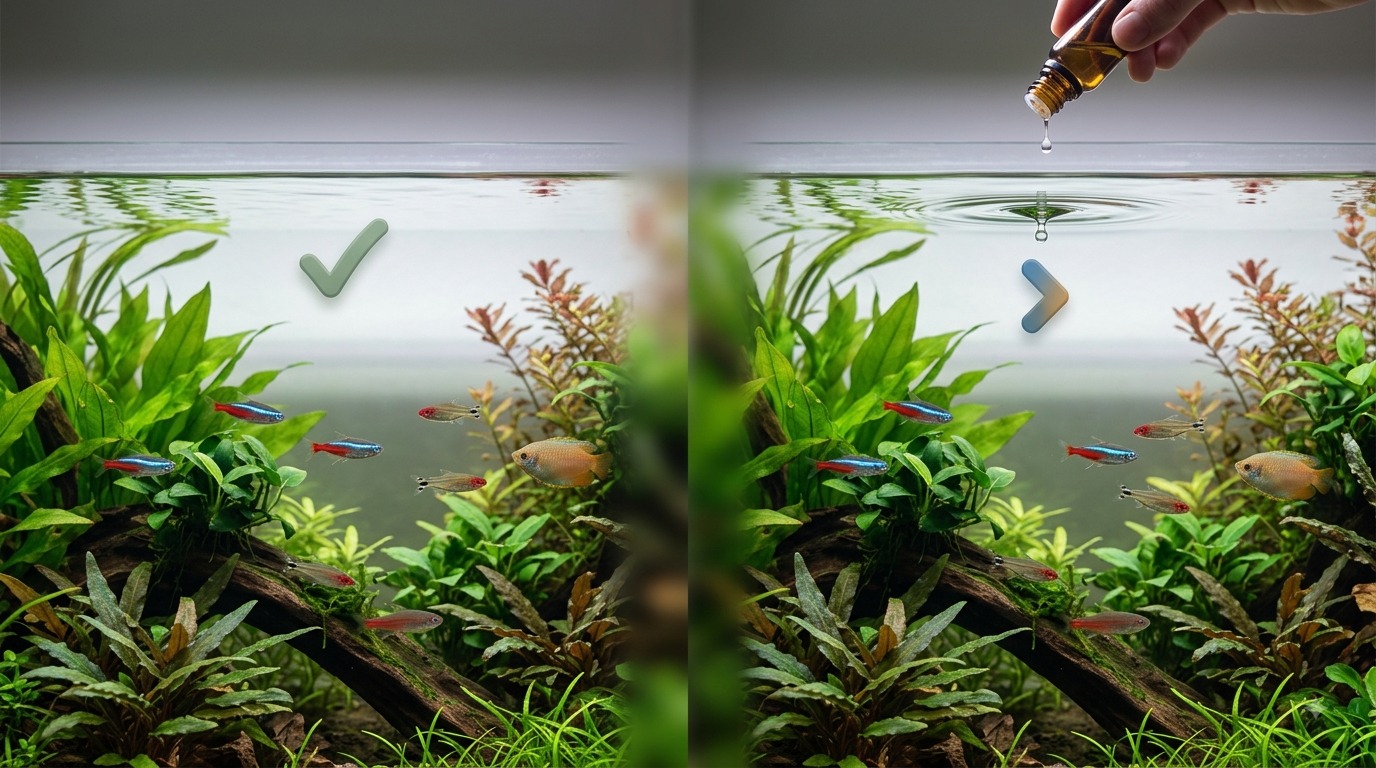
This advice exists because of how pH-adjusting products can behave in buffered water. If your KH is providing meaningful buffering capacity, a dose of pH-down is often absorbed by that reserve almost immediately — the reading barely moves, so it can look like the product isn't working. Add more, and the same thing tends to happen again. Each dose quietly spends some of that buffering capacity rather than doing much to the pH itself, until there's little buffering left. At that point, a dose similar in size to the ones before it can drop the pH sharply and unpredictably, because there's finally little left to absorb it. How quickly this happens, and how dramatic the eventual drop is, depends on the product, the dose, and how much buffering the water started with — it doesn't play out identically in every tank.
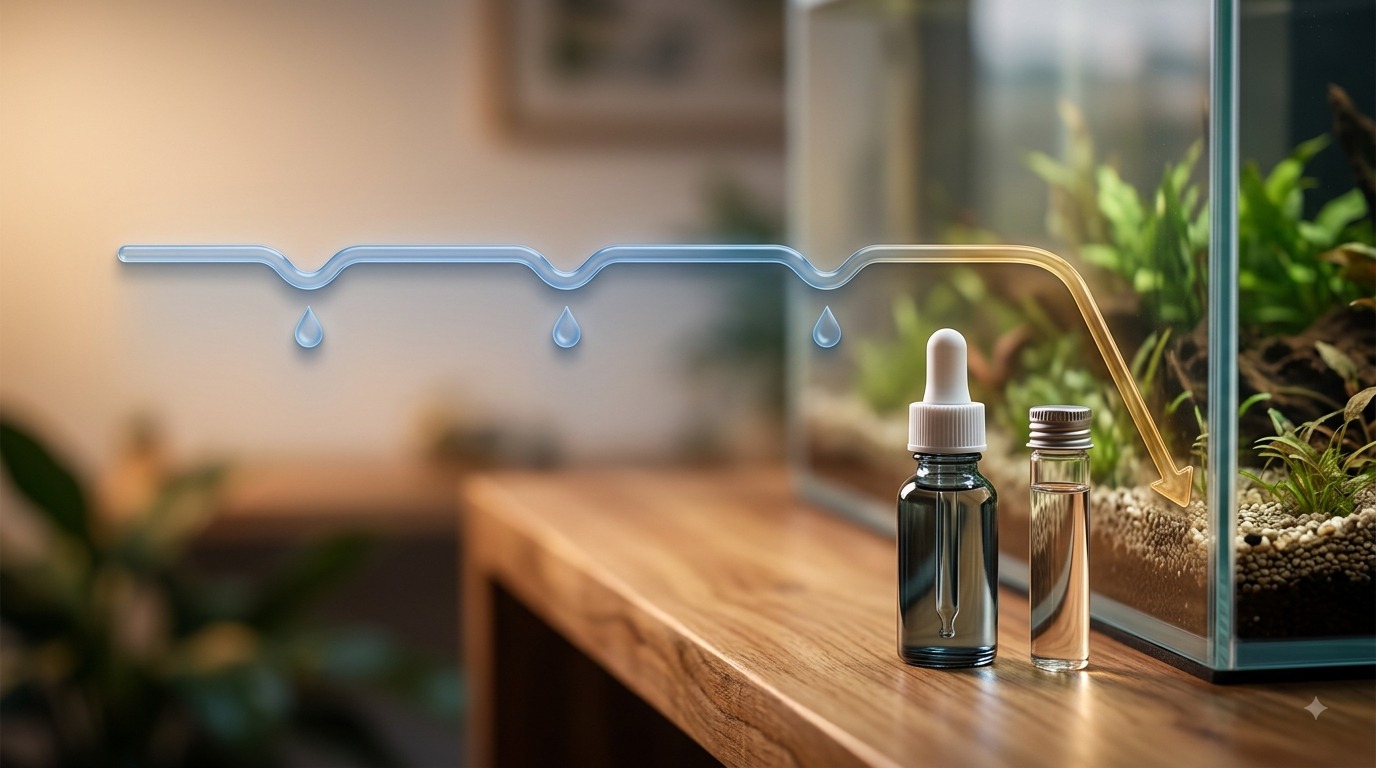
The advice is really about method, not goal. Repeatedly dosing chemicals against your water's existing buffering doesn't tend to work well, and that's where this saying earns its keep. Changing the water that's actually going into the tank — through dilution, remineralization, or a substrate designed for the job — is a different approach entirely, and it's generally a more controlled way to make a deliberate water chemistry change than reacting to the tank's pH reading over and over.
"Stable pH Is More Important Than the Correct pH"
There's a genuinely useful idea underneath this one. A lot of fish tolerate a wider pH range than care sheets suggest, and a sudden swing is generally harder on a fish than a pH reading that simply isn't textbook-perfect. Part of why sudden upward swings matter has less to do with pH on its own and more to do with ammonia — as pH rises, any ammonia already in the water becomes more toxic, which is one specific, well-understood reason rapid pH increases deserve real caution.
But "stable" isn't the same as "appropriate for what you're keeping." A wild-caught, soft-water species held long-term in hard, alkaline water isn't unstable — it's just consistently in the wrong environment. And stability says nothing about breeding requirements, which are frequently far narrower than maintenance requirements no matter how steady the water is.
"Fish Will Adapt"
There's some truth here, but it covers a few different things people often treat as one and the same.
An individual fish adjusting to your specific water over days or weeks is acclimation — a real, well-documented process, but a temporary one in the sense that it doesn't change what the fish fundamentally needs. Generations of a species line becoming more tolerant of a particular water chemistry through selective breeding is a different, much slower process — genuine adaptation at the population level. Wild-caught fish haven't been through that generational process at all, which is one reason "fish will adapt" applies to them far less reliably than it might to fish that have been captive-bred for many generations.
Neither acclimation nor adaptation guarantees a fish will thrive, and neither guarantees it will breed successfully. A fish can tolerate water it wouldn't choose without doing especially well in it, and reproduction often has narrower requirements than day-to-day survival, regardless of how well-acclimated or well-adapted the fish appears to be.
How Do I Actually Adjust GH, KH, or pH?
Different methods affect different parts of this system, and they don't substitute for each other. Something that raises KH won't necessarily touch GH. Something that raises GH won't necessarily do anything to your buffering at all.
| Method | Mainly Changes | Worth Knowing |
|---|---|---|
| Crushed coral / aragonite | GH and KH together, and generally supports a higher, more stable pH | Dissolves faster in soft, acidic water and slows down as water gets harder and more alkaline — how much it does depends on your water, flow, and how much you use |
| Baking soda (sodium bicarbonate) | KH only | Adds no calcium or magnesium at all |
| RO water | Removes essentially everything | Needs deliberate remineralization — straight RO isn't ready-to-use aquarium water |
The full breakdown of dosing, RO remineralization, crushed coral placement, and when each method actually makes sense lives in our companion guide: How to Safely Raise or Lower Aquarium GH, KH, and pH.
Frequently Asked Questions
What should GH be in a freshwater aquarium?
There's no single correct number — it depends on what you're keeping. Most community fish do fine across a fairly wide range once established. Shrimp and snails need enough calcium and magnesium available to support molting and shell growth, which makes GH a more meaningful number to watch for them than it is for most fish.
What should KH be in a freshwater aquarium?
Enough to keep pH from swinging unpredictably, which for most stocked community tanks means somewhere in the moderate range. Plenty of healthy, deliberately soft-water tanks run at very low KH by design, provided they're maintained with that in mind.
Does high pH mean hard water?
No, not reliably. pH and hardness (GH) are separate measurements and don't reliably predict each other. Softened tap water is a clean example — it can be soft by GH and still sit at a stable, high pH.
Can I have high GH and low KH?
Yes, and it's more common than people expect. It usually means the calcium and magnesium in the water arrived paired with something other than carbonate or bicarbonate, or that the water's buffering has been used up over time while the mineral content stayed put.
Is high GH bad for fish?
Generally not, for the species most people keep. It matters more for shrimp and snails, and for fish specifically adapted to very soft water.
Is low KH dangerous?
Not by itself. It means less resistance to pH swings, which matters far more in a heavily stocked tank with irregular maintenance than in a lightly stocked, consistently maintained one.
Should I lower my aquarium's pH to match a care sheet?
Not automatically. Check whether the fish is farm-raised or wild-caught, whether you're keeping it or breeding it, and whether it's actually showing any sign of a problem before deciding the number itself needs to change.
Does crushed coral raise GH, KH, or pH?
Generally, yes — it can raise both GH and KH and help support a higher, more stable pH as it slowly dissolves. How much and how quickly depends on your water's existing chemistry, flow, and how much you use. It tends to dissolve faster in soft, acidic water and becomes less effective as water gets harder and more alkaline, but that's a tendency rather than a guaranteed cutoff — it isn't something you can add without limit and expect it to stop automatically at the right numbers.
Does driftwood lower pH?
Sometimes, and it depends heavily on existing KH. In well-buffered water, driftwood will tint the water without meaningfully changing pH, because the buffering absorbs whatever acidity it releases. In very low-KH water, the effect is much more noticeable.
Do I need RO water if my tap water is hard?
Not necessarily. Plenty of species — and most commercially raised community fish — do well in hard water. RO becomes genuinely useful when you're keeping something that specifically needs soft water, or when your source water is extreme for what you're trying to do.
Testing your water is valuable because it gives you information, not because every reading is a problem waiting to be solved. Understanding what GH, KH, and pH are each actually telling you — and just as importantly, what they aren't — is what turns a test kit into a useful tool instead of a source of anxiety.
We talk through all of this in more depth, including some real tank scenarios, on Tank Guide Life, a product of FishKeepingLifeCo.
Tank Guide Life by FishKeepingLifeCo
Confused by GH, KH, or pH? Listen Before You Adjust
Before reaching for a water-treatment product, hear how GH, KH, and pH affect aquarium stability. Tank Guide Life helps you understand what your test results mean—and when leaving stable water alone is the better choice.
Listen on Spotify
Track water parameters, maintenance, and tank changes with our journals and guides.