Hard Water vs. Soft Water: Does Your Livestock Actually Need Something Different?
The Tank Guide · A FishKeepingLifeCo publication — Aug 2026
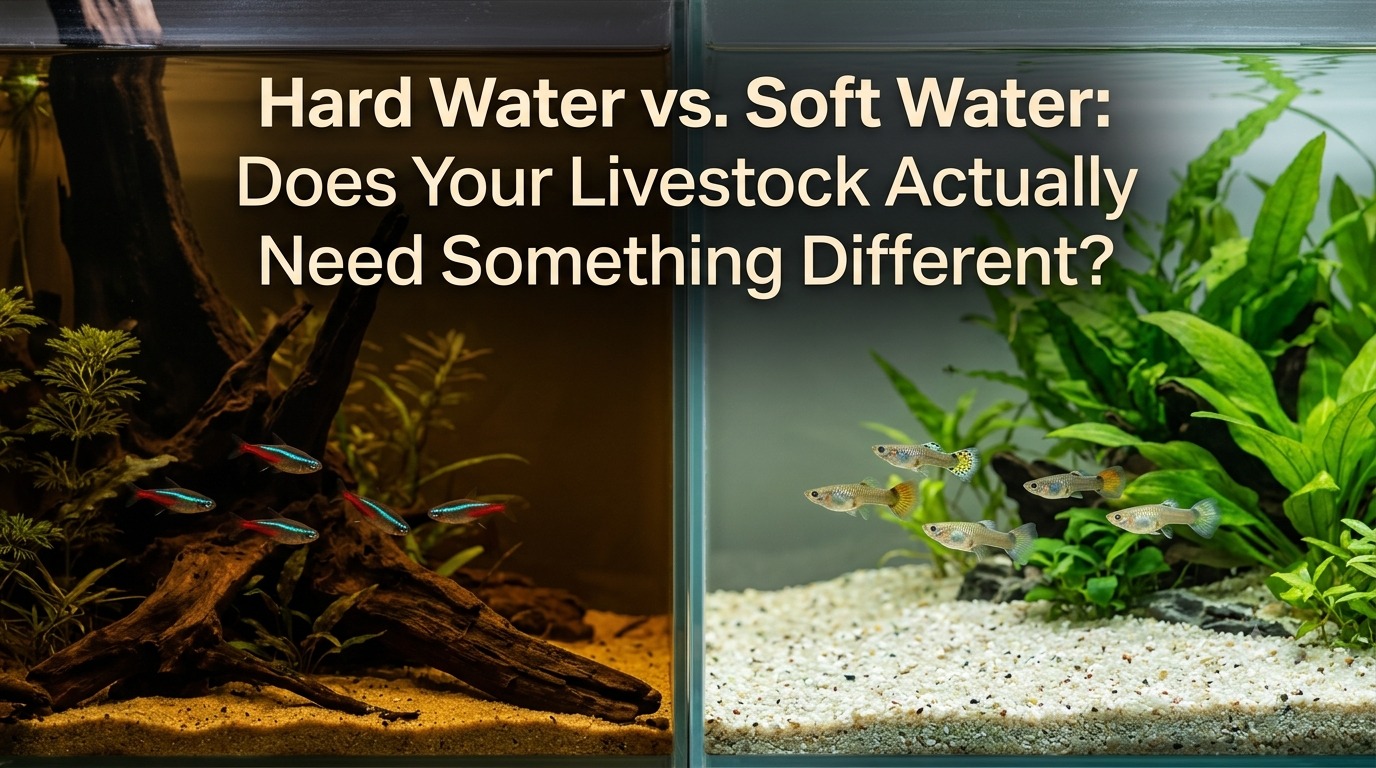
Look up water parameters for a cardinal tetra, then do the same for a guppy, and you'll quickly see how different their recommended ranges can be. That isn't a contradiction — those two fish come from very different kinds of water.
The trouble starts when aquarium advice gets flattened into one general idea of what "good water" is supposed to look like. Some species genuinely do better in soft, acidic water. Others are built for harder, more alkaline conditions. And some shrimp and snails have mineral needs that go beyond simple preference — closer to a requirement than something they'd merely benefit from.
This is about sorting out which is which, and what to actually do when your water and a care sheet disagree.
What Actually Determines Whether a Species Needs Different Water?
Three things matter most: where the species' wild population actually lives, whether the individual fish in front of you is captive-bred or wild-caught, and whether you're simply maintaining it in good health or also planning to breed it. All three can change what water conditions make the most sense, sometimes considerably.
(If you want a deeper look at why calcium, magnesium, and buffering matter in aquarium water, our guide to GH, KH, and pH explains that side of it in more detail.)
| Category / livestock type | Typical Origin | Keeping (Maintenance) | Breeding |
|---|---|---|---|
| Soft-water specialists (cardinal tetra, wild bettas, many Apistogramma) | Soft, acidic, mineral-poor | Often tolerant of harder water once captive-bred | Frequently needs genuinely soft, acidic conditions |
| Hard-water specialists (mollies, Rift Lake cichlids) | Hard, alkaline, mineral-rich | Tolerant of a range, though very soft water is a real problem for some (mollies especially) | Generally more forgiving, though Rift Lake cichlids still need real alkalinity |
| Broadly adaptable (danios, most tank-bred corydoras, bristlenose pleco) | Variable | Very tolerant | Rarely picky |
| Shrimp and snails, especially Caridina and calcifying snails | Ranges from soft to moderate | GH functions closer to a nutritional requirement than a preference | Often needs specific, narrow conditions |
Soft-Water Fish
Species from soft, acidic water — mostly Amazonian and Southeast Asian in origin — tend to come from water with very little calcium, magnesium, or buffering at all.
| Species | Wild Water | Worth Knowing |
|---|---|---|
| Cardinal tetra | Rio Negro system; very soft, acidic | Farmed stock is considerably more tolerant than wild-caught; breeding still typically calls for soft, acidic conditions |
| Neon tetra | Soft, acidic South American water | Among the most adaptable soft-water fish as farmed stock |
| Discus | Amazon floodplain; soft, warm, acidic | Farmed stock tolerates a wider range for maintenance; hard water frequently interferes with egg fertilization and hatching |
| German blue ram | Llanos savanna; soft, warm | Widely considered fragile — but that reputation may have more to do with intensive commercial breeding practices than water chemistry specifically |
| Rasboras (Trigonostigma, Boraras) | Southeast Asian peat swamp; very soft | Generally adaptable as farmed stock; Boraras species somewhat less so |
| Corydoras | Varies widely by species | Most tank-bred species are quite adaptable; a cooler, softer water change is a common spawning trigger |
| Apistogramma | Soft to very soft, species-dependent | Some species are genuinely narrow in their needs; pH during development can even influence sex ratio in a few |
| Wild Betta species (not the common Betta splendens) | Peat swamp forest; very soft, very acidic | Genuinely require soft, acidic water — this is need, not preference |
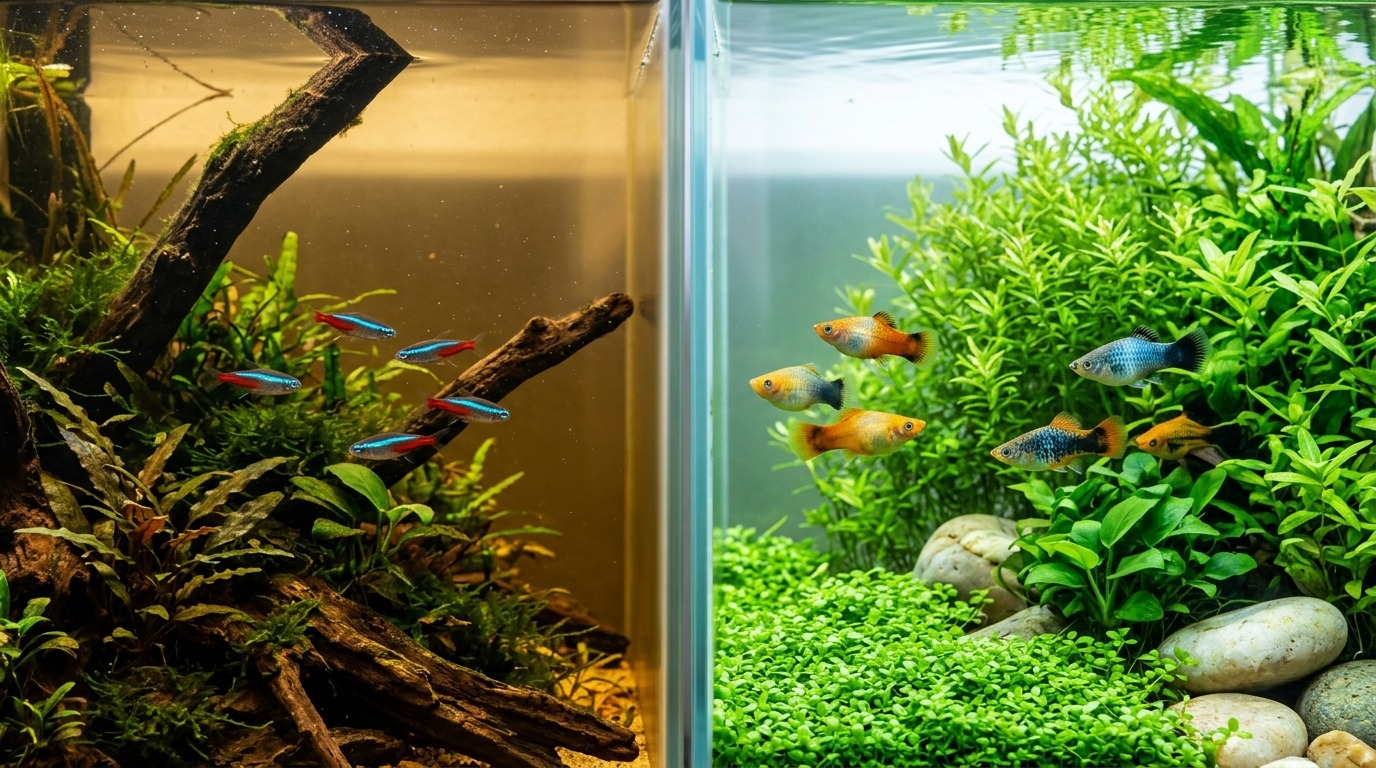
Hard-Water Fish
| Species | Wild Water | Worth Knowing |
|---|---|---|
| Guppy | Variable, often hard and alkaline | Extremely adaptable; modern fancy strains' fragility is usually about inbreeding and disease load, not water chemistry |
| Molly | Often hard, alkaline, sometimes brackish | Genuinely mineral-demanding — soft water is a well-recognized, real problem for mollies specifically |
| Platy, swordtail | Central American hard, alkaline streams | Adaptable, but do best in moderate-to-hard water |
| Lake Malawi cichlids | Alkaline (roughly pH 7.7–8.6), only moderately hard | Often assumed to need extreme hardness — the alkalinity and pH matter more than GH does |
| Lake Tanganyika cichlids | Very alkaline (roughly pH 8.6–9.2), sodium/potassium-bicarbonate water | KH actually runs higher than GH in this water — an unusual profile worth knowing if you're mixing your own |
| Central American cichlids | Hard, alkaline, limestone-influenced | Generally forgiving |
| Goldfish | Hard, alkaline preferred | Heavy waste producers benefit from the buffering reserve that comes with harder water |
| Most freshwater snails | Calcium-bearing water | Covered in more depth below — closer to a requirement than a preference |
Most Community Fish Are More Adaptable Than Their Care Sheet Suggests
Zebra danios and most Danio species, white cloud mountain minnows, most tank-bred Corydoras, cherry barbs and most Puntius/Pethia barbs, bristlenose plecos, kuhli loaches, Betta splendens, most tank-bred rainbowfish, Endler's livebearers, Amano shrimp, and Neocaridina davidi all fall into this category. For these, water chemistry is rarely what separates a healthy tank from a struggling one — feeding, general water quality, and appropriate tankmates tend to matter more.
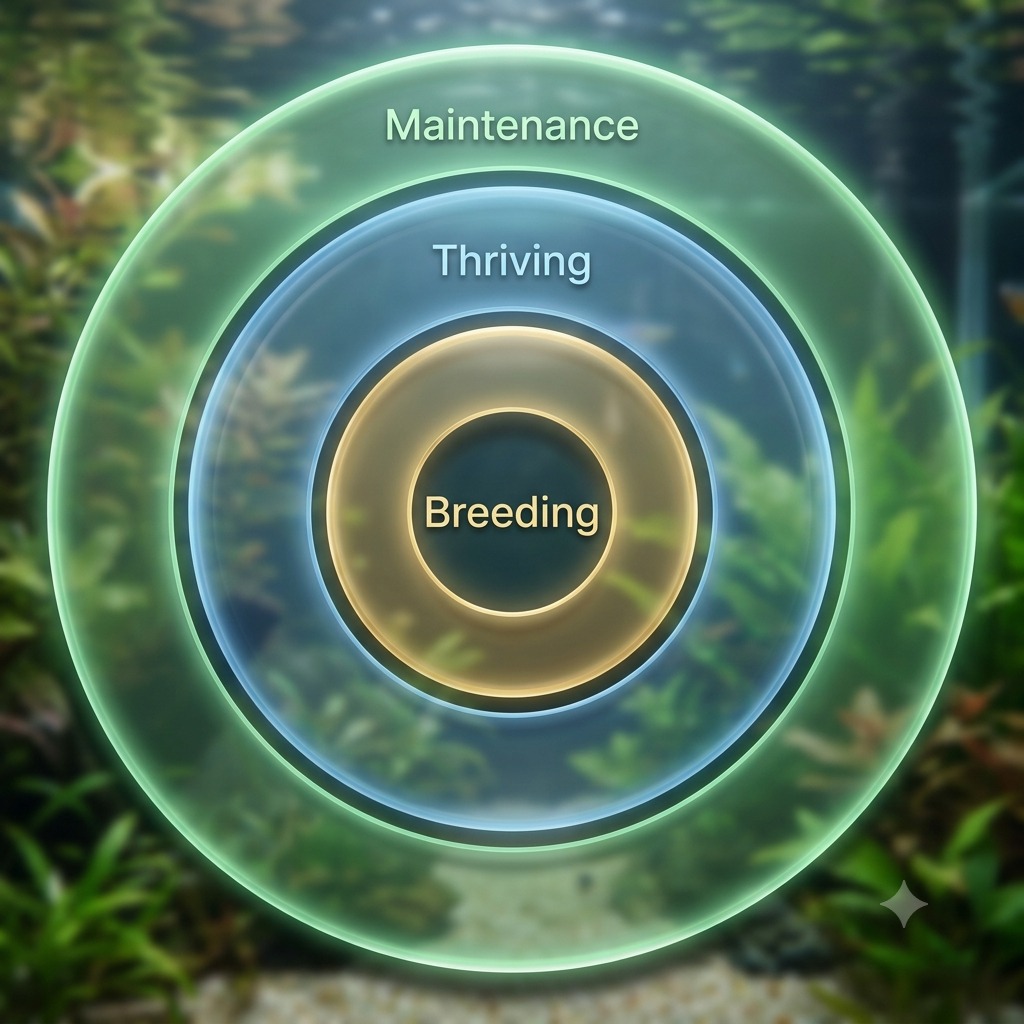
Survival, Thriving, and Breeding Aren't the Same Question
A care sheet range usually doesn't specify which of these three it's describing, and they carry very different levels of evidence behind them.
Survival has the widest range by far. Reasonably healthy fish tolerate a broader span of water chemistry than most hobbyists assume — for many species, the gap between "this would eventually cause real harm" on either end is considerably wider than a typical care sheet implies.
Thriving is a little harder to pin down. There's a lot of useful experience out there from breeders and longtime keepers, but far less controlled research showing that a fish will consistently do better at one exact GH or pH than another. That doesn't make hobby experience unimportant — it just means those recommendations are often better treated as informed guidance than as hard biological limits.
Breeding is often genuinely narrow, and it's where water chemistry most reliably makes a practical difference. Fertilization, egg hardening, and hatch rates in a lot of soft-water species depend on low mineral content and low conductivity in ways that day-to-day health simply doesn't.
The upshot: a fish living outside its "ideal" range isn't automatically in trouble. A fish you're trying to breed outside that range is a genuinely different situation.
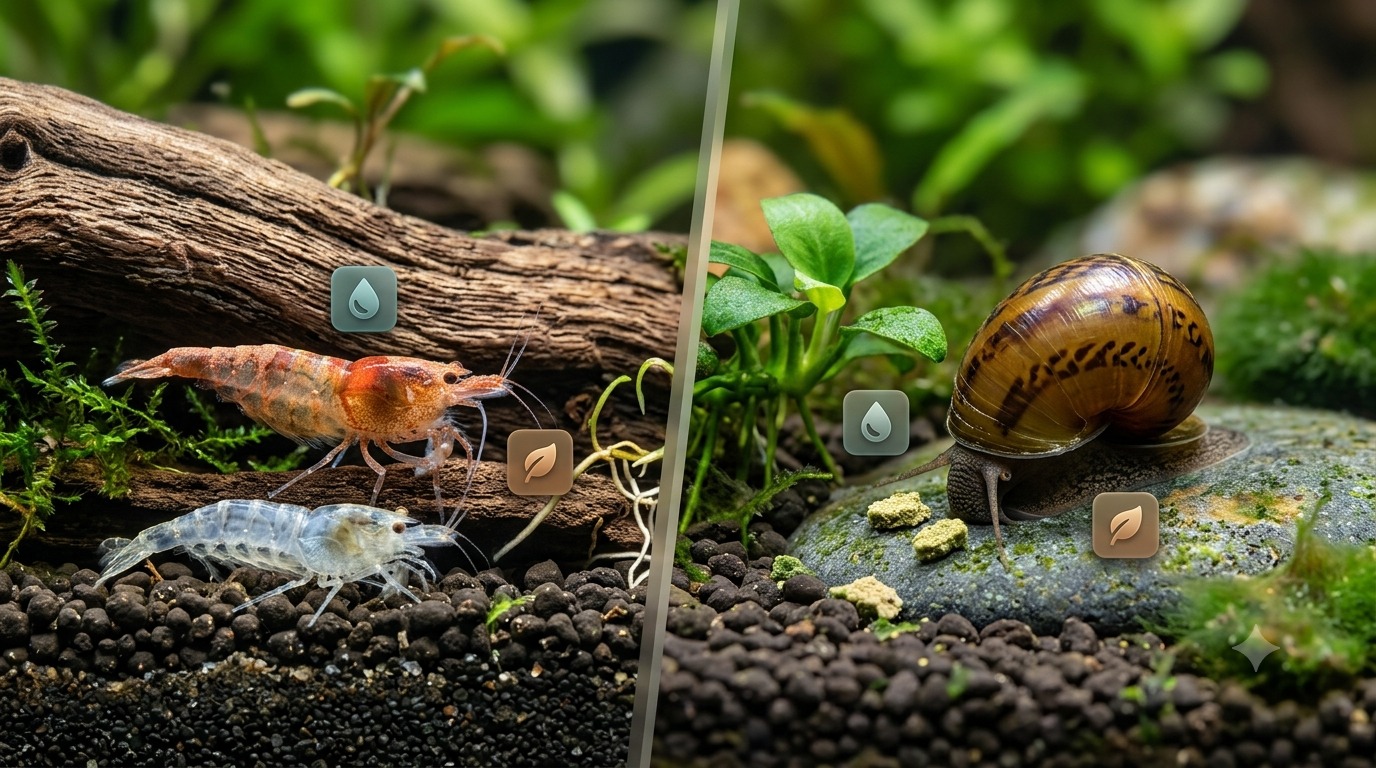
Shrimp and Snails Are a Different Situation
For most fish, GH is something worth keeping in mind. For shrimp and snails, it functions closer to a nutritional requirement.
Shrimp periodically molt — shedding an old exoskeleton and hardening a new one underneath. Calcium and other minerals in the water support that process alongside diet, and when GH runs low, there may not be enough calcium available for a shrimp to properly harden its new shell. A failed molt is usually fatal. Snails face something similar: their shells are built from calcium carbonate and can visibly erode in water without enough mineral content and buffering to support them — damage that doesn't reverse once it's happened, though new growth can be healthy again once the water improves.
| Parameter | Neocaridina (cherry, etc.) | Caridina (crystal, bee, Taiwan bee) |
|---|---|---|
| Typical GH | Roughly 6–14 dGH (sources vary quite a bit) | Roughly 4–6 dGH |
| Typical KH | 2–8 dKH | Very low — often 0–2 dKH |
| Typical setup | Often does fine on tap water | Usually built around RO water, a GH-only remineralizer, and active substrate working together |
| Difficulty | Beginner-friendly | More advanced — the pieces depend on each other |
The wide spread in the Neocaridina GH figures above isn't sloppiness — different sources genuinely report different numbers, which is itself a decent sign that the species tolerates a fairly broad range and that no single figure should be treated as a hard requirement.
One thing a GH reading won't tell you: the split between calcium and magnesium, and shrimp need both. Crushed coral, aragonite, and cuttlebone — common ways to raise GH — supply calcium only. A tank with an "adequate" GH built entirely from one of these can still leave shrimp short on magnesium specifically, worth knowing if molting problems continue despite a GH reading that looks fine on paper. Nerites and mystery snails tend to be particularly demanding of calcium; ramshorn and bladder snails are generally more tolerant. The apex — the oldest part of the shell — is usually where erosion shows up first.
(If GH genuinely needs raising for shrimp or snails, here's how to do it without shocking the tank.)
Does Captive-Bred Mean the Water Doesn't Matter?
Not automatically, and it's worth being specific about why.
Farmed fish can tolerate a wider range than their wild ancestors, but that tolerance isn't automatic or uniform. It comes from some combination of the actual conditions a given farm raises them in, selective breeding within that particular strain, the fish's own acclimation over its lifetime, and general husbandry — and it varies noticeably between different breeding lines of the same species. A farmed cardinal tetra handling considerably harder water than its wild counterpart is a well-documented pattern; it doesn't mean every captive-bred fish is equally flexible, or that farmed stock has no requirements at all.
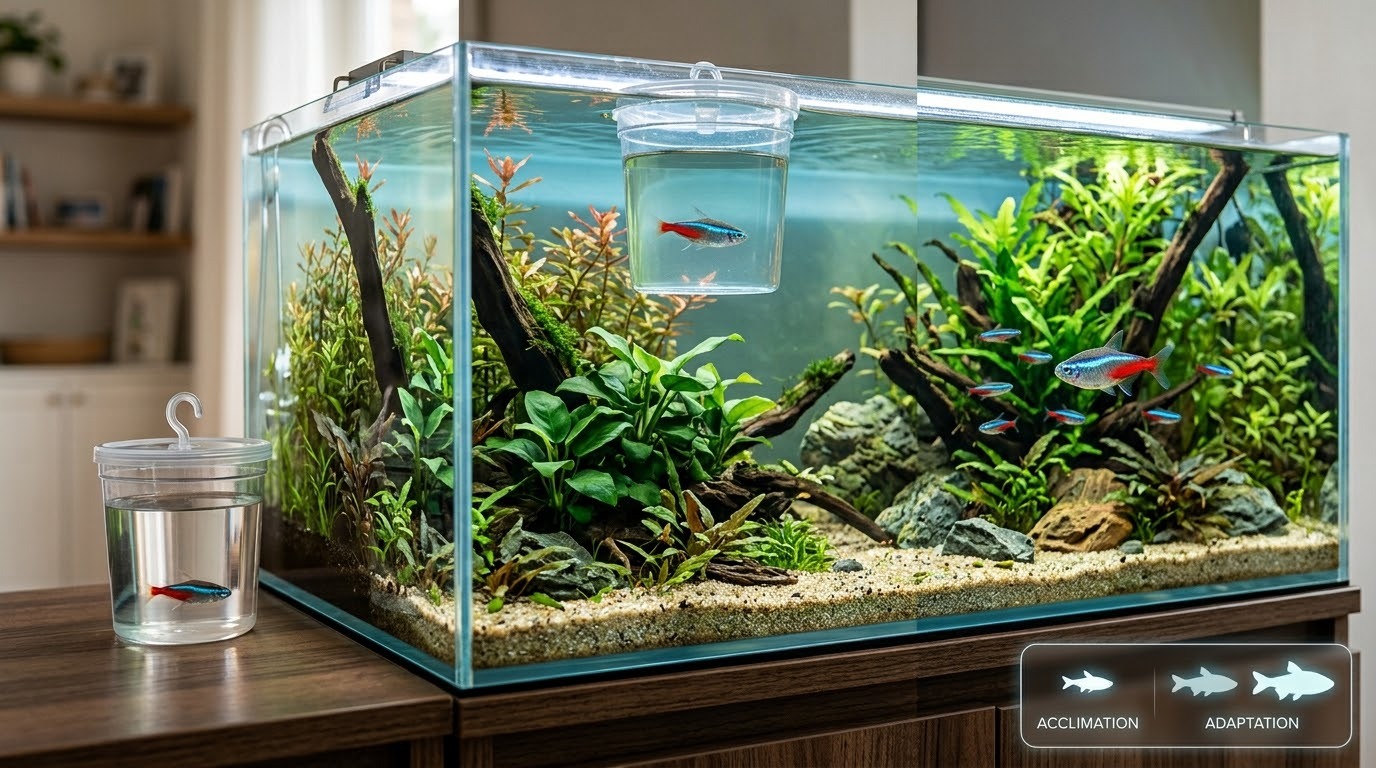
It's worth being precise about two different things here, since they tend to get used interchangeably. Acclimation is something an individual fish does — adjusting to the specific water it's living in, over days or weeks. Adaptation happens at the level of a species or strain, built up over many generations of breeding in particular conditions. A farmed cardinal tetra's broader tolerance for harder water is adaptation. A fish settling into your tank after you bring it home is acclimation. They're related, but one doesn't substitute for the other.
That distinction has a practical consequence: a strain that has adapted to tolerate a wide range still needs each individual fish to acclimate properly when it's moved. A fish can be perfectly capable of living in both its old water and your new water and still be stressed if the change between the two happens too quickly — being captive-bred, or generally adaptable, doesn't mean immune to a rapid shift. This comes up most often when bringing a new fish home from the store, receiving shipped livestock, or deliberately changing GH, KH, or pH in a tank that already has fish in it. In all three cases, a gradual, deliberate transition tends to matter more than reaching the exact right number quickly.
Wild-caught fish haven't been through generations of that adaptation process. They're the population the "ideal" numbers were often originally describing, and they tend to have the least flexibility of any group discussed here — which also means they deserve extra care during acclimation specifically, not just extra caution about long-term water chemistry.
Where Do Care-Sheet Numbers Actually Come From?
Often, nobody says. A single published range can be built from wild habitat surveys, a breeder's personal notes, one keeper's own tank, or simply copied from another website — and most sources don't tell you which.
One recognizable pattern: when a care sheet gives roughly the same range — something like pH 6.5–7.5 — for a cardinal tetra, a mystery snail, and a Malawi cichlid alike, it's probably not describing anything species-specific. It's describing what typical tap water looks like, which is useful information but not the same thing as a finding about that fish.
What's generally reliable in a published range is the broad direction — this is a soft-water fish, this is a hard-water one. What's generally not reliable is the exact boundaries, or any assumption that the range was built with your fish's actual origin, wild or farmed, in mind. Targeting the precise middle of a published range isn't inherently better than sitting somewhere else within it. A stable tank that's simply within a workable range for the species usually matters more than hitting a specific figure.
So What Do You Actually Do With a Mismatch?
Start with what you're actually keeping, not with the number. A few questions worth working through: how far apart are your water and the "ideal" figure, actually? Is the fish captive-bred or wild-caught? Is the goal ordinary maintenance or breeding? Is the fish currently healthy, active, and behaving normally? And if a change does turn out to be warranted, how will it actually be introduced — as a single correction, or as a controlled transition over time?
A commercially raised, tank-bred community fish showing no signs of trouble in water that's a bit outside its "ideal" range usually doesn't need anything changed. A wild-caught specimen, or a breeding project involving a genuine soft- or hard-water specialist, is a different conversation — and in that case, changing your source water deliberately, and acclimating the fish to it gradually rather than all at once, tends to make more sense than forcing the display tank toward a number quickly.
(For the fuller decision framework — when adjusting is worth it, and when it isn't — see our guide to what GH, KH, and pH actually mean. Once you've confirmed an adjustment is actually warranted, here's how to do it without creating a new problem.)
Most fish sold in stores today have been bred for generations in whatever water their supplier uses, and most are considerably more adaptable than the internet gives them credit for. Knowing where a species actually sits — soft-water specialist, hard-water specialist, broadly tolerant, or a shrimp or snail with a genuine mineral requirement — is what turns "does my water match the chart" into a question you can actually answer.
Frequently Asked Questions
Do cardinal tetras need soft water?
Wild-caught cardinal tetras genuinely do, coming from some of the softest, most acidic water in the hobby. Farmed cardinal tetras — the large majority sold in stores — are considerably more tolerant for day-to-day keeping, though breeding them still generally calls for soft, acidic conditions.
Can guppies live in soft water?
Generally, yes, though they tend to do better in moderate-to-hard water, which is closer to where most guppy populations originate.
What GH do shrimp need?
It depends on the species. Neocaridina (cherry shrimp and similar) tolerate a fairly wide range, roughly 6–14 dGH depending on the source you check. Caridina (crystal, bee, and similar) generally need lower GH, closer to 4–6 dGH, along with very low KH.
Do snails need hard water?
Most calcium-carbonate-shelled snails need enough GH available to maintain their shells — less about "hard water" specifically and more about there being enough calcium and buffering present. Very soft, acidic water is a common cause of shell erosion.
Is my water too hard for a soft-water fish?
Depends on whether the fish is farmed or wild-caught, and whether you're trying to keep it or breed it. Farmed stock of most soft-water species handles moderately hard water for day-to-day keeping better than people expect; breeding is where hardness is more likely to actually matter.
Should I try to match my fish's exact wild habitat parameters?
Not usually necessary for maintenance, especially with farmed stock. It becomes more relevant with wild-caught fish, or when breeding a species with genuinely specific requirements.
Do wild-caught fish need different water than store-bought ones?
Often, yes. Wild-caught fish haven't been through generations of farm conditions and tend to have narrower tolerance than farmed stock of the same species.
Will my fish breed if my water isn't "ideal"?
Depends heavily on the species. Plenty of fish live for years in water outside their "ideal" range without issue, but won't reproduce successfully outside a narrower window — breeding tends to be pickier than day-to-day health.
We get into more of these species-specific examples — including a few surprising ones — on this episode of Tank Guide Life, a product of FishKeepingLifeCo: Aquarium GH, KH & pH | When to Adjust Your Water (and When to Leave It Alone). Give it a listen on Spotify or wherever you get your podcasts.
Track water parameters, maintenance, and tank changes with our journals and guides.