How Houseplants Grow With Roots in Aquarium Water
The Tank Guide · A FishKeepingLifeCo publication — Jul 2026
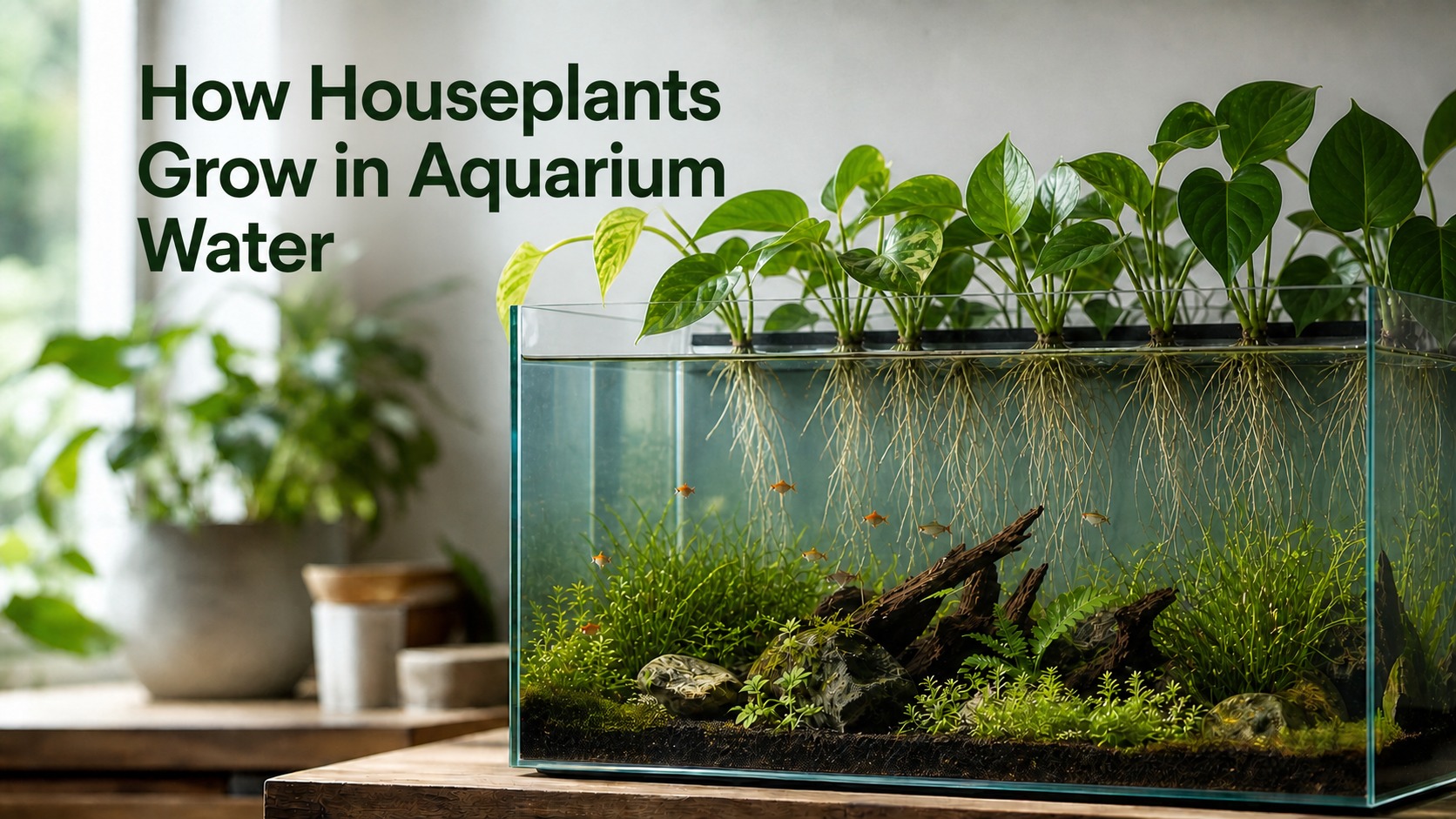
Part of our Complete Guide to Growing Houseplants in Your Aquarium.
The Oxygen Science
Houseplants can grow in aquarium water because waterlogged soil starves roots of oxygen, while oxygenated, moving aquarium water supplies both moisture and oxygen at once.
At first, it seems to make no sense.
If overwatering is one of the most common ways people accidentally kill houseplants, why would placing those same roots directly into aquarium water work?
The answer is that water itself usually isn't the problem. The environment around the roots is.
Roots need both water and oxygen to stay healthy. When potting soil remains saturated for long periods, the tiny air spaces between soil particles fill with water. Over time, repeated top watering can also cause potting mixes to settle and compact as the soil breaks down. Together, these changes reduce the oxygen available to the roots, making them more vulnerable to decay and disease.
This is one reason many houseplant growers like self-watering pots or bottom watering, where moisture is drawn up from below instead of poured on top. Top watering is perfectly healthy when done correctly, but bottom watering can reduce soil disturbance and, with a well-draining mix, encourage better aeration around the roots.
A healthy aquarium is a very different environment.
Water is constantly moving through filters, around plants and decorations, and across the surface of the aquarium. That movement helps replenish dissolved oxygen, giving adapted roots access to both the water and oxygen they need.
In other words, the roots aren't surviving because they're underwater—they're thriving because the conditions around them are completely different from those found in waterlogged soil.
This is one of the biggest reasons hydroponics has become so successful.
Hydroponic growers don't remove soil and hope for the best. Instead, they replace everything the soil normally provides. The roots receive a constant supply of water, dissolved nutrients, oxygen, and physical support, allowing plants to grow without traditional garden soil.
Growing houseplants from an aquarium follows the same basic principle.
The aquarium provides water and dissolved nutrients, while filtration and water movement help keep oxygen available around the roots. The plant's leaves remain above the water, where they can receive light and exchange gases with the surrounding air.
Plants that are moved from soil into water often grow new roots that are better adapted to their new environment. It's normal for some older soil roots to die back while fresh water roots develop. This transition doesn't necessarily mean the plant is unhealthy—it is simply adapting.
This is also why many hobbyists find it easier to start with cuttings instead of fully established potted plants. New roots formed directly in aquarium water are already adapted to those conditions from the very beginning.
One final point is worth remembering: although the roots are underwater, the rest of the plant usually is not.
Most of the houseplants commonly grown from aquariums take on an emergent form. Their roots remain below the waterline while their stems and leaves grow above the surface. Unlike true aquatic plants, they are not adapted to spend their entire lives completely submerged.
Once you understand that difference, growing pothos, Monstera, philodendrons, and many other terrestrial plants from an aquarium starts to feel much less mysterious. Instead, it becomes another example of how plants simply adapt when their basic needs are met.
How Houseplants Use Aquarium Nutrients and Nitrates
Once the roots are established, the aquarium becomes more than a source of water. It also becomes a steady source of nutrients.
Those nutrients begin with the normal activity inside the tank. Fish release ammonia through their gills and produce solid waste, and uneaten food, dying leaves, and other organic material break down over time. As that happens, nutrients are released into the water and become part of the aquarium's natural cycle.
This is where beneficial bacteria do some of the most important work.
They convert ammonia into nitrite and then nitrate. Ammonia and nitrite are highly toxic to fish, while nitrate is generally less toxic but can still build up if it is not removed or used.
If you're still cycling a new tank, our Cycling Coach can help you get that bacterial colony established before adding plants or fish.
Houseplants can absorb some of that nitrate through their roots and use the nitrogen to build new growth.
That does not mean the plants are directly eating fish waste. Solid waste first has to break down, and much of that nitrogen is typically processed by beneficial bacteria before it becomes available to the plant. The fish, bacteria, and plants are all doing different parts of the same job.
The fish produce waste.
The bacteria transform it.
The plants use part of it to grow.
And that growth is where the nutrients go. Nitrate does not simply disappear. The plant uses it to build roots, stems, leaves, chlorophyll, proteins, and other living tissue. In a healthy, fast-growing plant, much of that nitrogen ends up stored in new growth.
This is also why pruning matters. When you trim a plant or remove a cutting for propagation, you are physically removing the nutrients stored inside that growth from the aquarium system. If an old leaf dies and falls back into the tank, some of those nutrients can be released again as it decomposes.
Nitrogen may get most of the attention, but it is not the only thing houseplants use. Depending on what is available, their roots may also absorb phosphorus, potassium, iron, magnesium, and other trace elements. Their leaves stay above the surface, where they can take in light and pull carbon dioxide straight from the air.
That gives many terrestrial plants a real advantage. Because they are not limited to the carbon dioxide dissolved in aquarium water, they can often grow larger root systems and much more leaf mass than fully submerged plants. Fast-growing species such as pothos can turn a steady supply of light and nutrients into a surprising amount of new growth.
Those roots can spread surprisingly quickly, too. Some hobbyists contain the roots inside a hanging basket or plant holder, which keeps them clear of filter intakes and makes trimming easier (more on containment methods in our species, setup, and care guide). Other hobbyists prefer to let the roots grow freely throughout the aquarium. The wild root structure can create a natural underwater look while also providing cover and hiding places for fry, shrimp, and other small inhabitants.
Neither approach is automatically better. It depends on the appearance you want, the livestock you keep, and how much root maintenance you are comfortable doing.
Still, results vary from one aquarium to another. The amount of nitrate a plant can use depends on its size, growth rate, lighting, root mass, overall health, and the aquarium's bioload. A small cutting will not balance a heavily stocked tank overnight, but a healthy, established plant can become a valuable part of the system over time.
That is what makes these plants more than decoration. They become active participants in the aquarium's nutrient cycle.
Do Houseplants Really Reduce Aquarium Nitrates?
Houseplants can make a noticeable difference in aquarium nitrate levels, but their impact depends on how actively they are growing.
And it is important to remember that this is not an overnight change. When a plant first moves from soil into aquarium water, its roots need time to adjust—some old soil roots die back as new water-adapted roots form—and during that stretch, the plant is focused more on survival than on rapid nutrient uptake.
Once the plant settles in and begins producing steady new growth, its effect on the aquarium can become much more noticeable.
Growth rate matters because plants only use nutrients while they are actively growing. A large, established pothos with a healthy root system and plenty of leaves will usually absorb more nitrogen than a small cutting that has only just begun to root. A struggling or stalled plant will do very little, no matter how much of its root system is sitting in the water.
The aquarium's bioload matters just as much. More fish, heavier feeding, and more decomposing organic material all create more nitrogen for the system to process. In a lightly stocked aquarium, a few healthy houseplants may have a noticeable effect. In a heavily stocked tank, nitrate may be produced faster than the plants can use it.
Not sure where your tank falls? Our Stocking Advisor can help you gauge your current bioload.
That is why one small pothos cutting should never be treated like a magic nitrate remover.
Success also does not always mean bringing nitrate all the way down to zero. In many aquariums, the biggest benefit is that nitrate rises more slowly between water changes. The plants may help keep levels steadier or reduce how much accumulates over time. Sometimes the improvement is obvious on a test kit. Other times, it shows up as a slower trend over several weeks.
That is why patience matters.
If you want to see how much of a difference the plants are making, test your nitrate before adding them and keep your feeding and maintenance routine as consistent as possible. Then test again at the same point in your maintenance cycle over the next several weeks.
You are looking for a pattern, not an instant drop.
Species, lighting, temperature, and overall health all play a role too. Other plants in the aquarium may also compete for some of those same nutrients.
Houseplants may help with algae by competing for nutrients, but they are not an algae cure. Excess lighting, overfeeding, poor maintenance, low water flow, and unstable conditions can still create algae problems even when large terrestrial plants are growing from the aquarium.
It is also possible for nitrate to become too low in some planted systems. Plants still need nitrogen to grow, and stripping too much from the water can contribute to weak growth, yellowing leaves, or other signs of deficiency—the goal was never zero nitrate, just balance.
Houseplants also do not replace water changes. Water changes remove more than nitrate. They help dilute dissolved organic compounds, excess minerals, contaminants, medication residues, and other substances that plants may not use. They also give you a chance to inspect the aquarium, clean where needed, and catch small problems before they become larger ones.
The best way to think about houseplants is not as a replacement for aquarium maintenance, but as another living part of the system that helps share the workload.
Give the roots time to adapt, give the plant enough light to grow, and judge its impact over weeks—not days.
Now that you know why it works, the next question is which plants to choose and how to add them safely — see our full species guide, setup, and care instructions.
Frequently Asked Questions
How long does it take a houseplant to adapt to aquarium water?
There is no exact timeline.
A cutting may begin producing roots fairly quickly, while a soil-grown plant may take several weeks to replace older soil roots with roots better adapted to water. Some wilting, yellowing, or limited root dieback can happen during the transition.
Look for new roots and leaves rather than judging the plant after only a few days.
Can aquarium water be used on houseplants or garden plants?
In many cases, yes. Water removed during routine aquarium maintenance may contain nitrate and other dissolved nutrients that ornamental plants can use. It should not be treated as a complete fertilizer, but reusing it can be better than pouring it down the drain.
Carnivorous plants are an important exception. Many species are adapted to nutrient-poor, low-mineral conditions and may be damaged by the dissolved nutrients and minerals found in aquarium water. Depending on the species, distilled water, reverse-osmosis water, or clean rainwater is usually a safer choice.
Avoid using aquarium water on edible crops if the tank has been treated with medications, salt, copper, algaecides, or other products not intended for food production.

Log trimming, dosing, and water tests with our journals and guides.