Tiny White Worms and Bugs in Your Aquarium: What Are They, and Should You Worry?
The Tank Guide · A FishKeepingLifeCo publication — Sep 2026
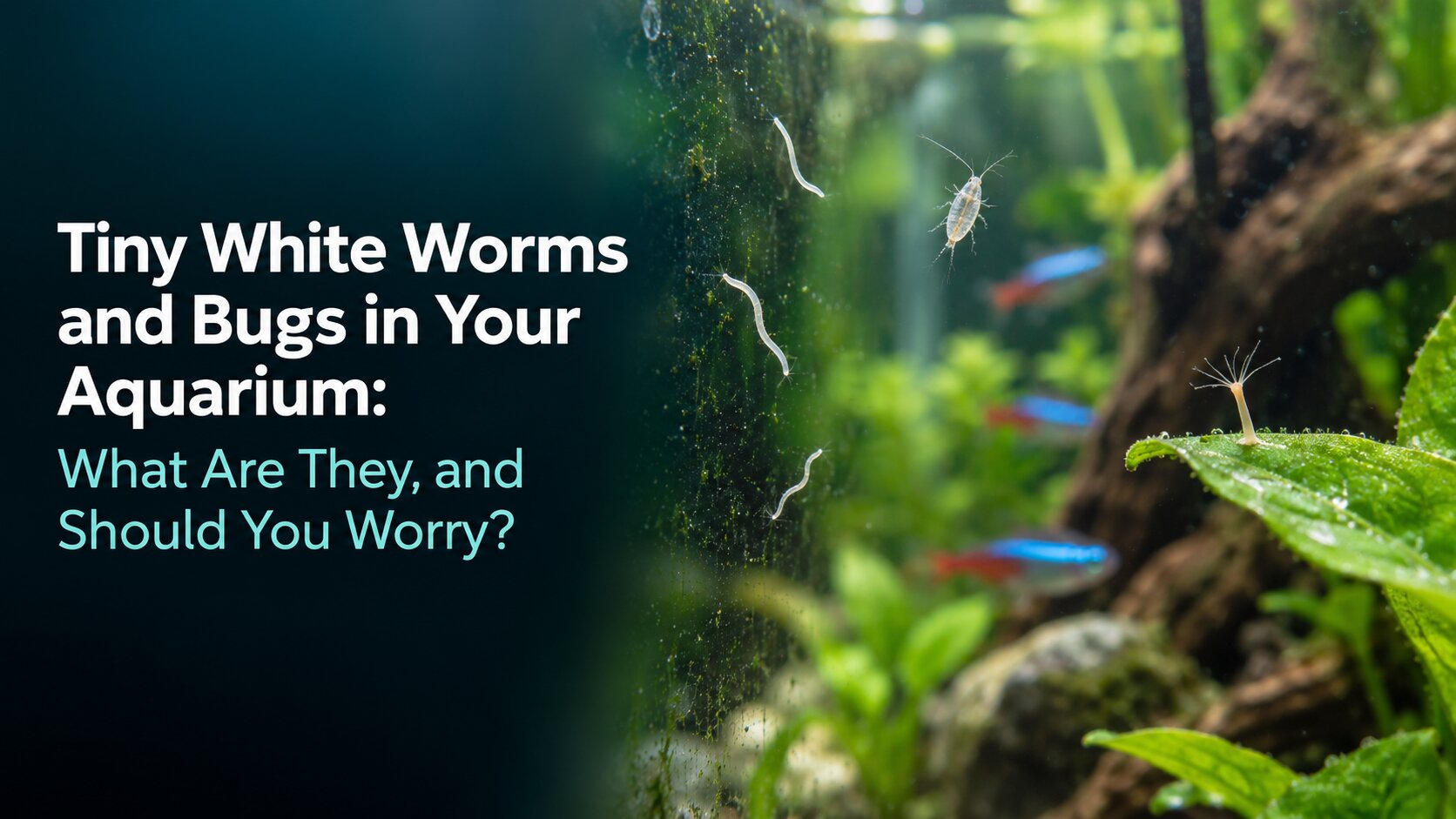
You lean in to feed your fish and notice a tiny white thread wriggling on the glass. Or something flat gliding across the substrate. Or a speck with little tentacles clinging to a plant leaf.
What is it? Where did it come from? And should you be worried?
Here’s the short answer: Most tiny worms and bugs found in freshwater aquariums are free-living organisms. Many are harmless, some help process organic material, and a few can prey on vulnerable aquarium animals.
The important question isn’t simply whether an organism is present. It’s what that organism is and whether it poses a risk to the animals you keep.
These unexpected inhabitants are more common than you might think.
In a study of 55 home aquariums from 43 households in New Zealand, researchers recorded 55 different types of invertebrates that had arrived unintentionally. They included copepods, seed shrimp, water fleas, mites, flatworms, and roundworms.
A freshwater aquarium is an ecosystem, and the fish, shrimp, snails, and plants we intentionally add aren’t its only inhabitants.
This guide will help you identify the organisms you’re seeing, understand what they do, and determine what deserves your attention.
How to identify worms and bugs in your aquarium
Before attempting to remove anything, take a closer look.
You don’t need to identify an organism down to its scientific species immediately. Four basic observations can help narrow the possibilities.
- Shape: Is it thin and threadlike, flat like a ribbon, oval, shelled, tentacled, or equipped with legs?
- Movement: Does it wriggle, glide smoothly, thrash from side to side, hop through the water, or remain attached to a surface?
- Location: Is it on the glass, in the substrate, swimming freely, attached to a plant, or directly on one of your animals?
- Size: Is it barely visible, a few millimeters long, or closer to a centimeter?
Quick aquarium hitchhiker identification chart
| What you’re seeing | Possible identification |
|---|---|
| Thin white thread that wriggles | Detritus worm or roundworm |
| Flat worm gliding across the glass | Planaria or another flatworm |
| Tiny stalk with fine tentacles | Hydra |
| White dots moving in sudden hops | Copepods |
| Seed-shaped dots scurrying over surfaces | Seed shrimp |
| Curved, shrimp-like animal swimming sideways | Scud |
| Flattened worm moving like an inchworm | Leech |
| Insect-like creature with six legs and large eyes | Dragonfly or damselfly nymph |
These are identification clues, not definitive diagnoses. Different species and life stages can look surprisingly similar.
A magnifying glass, inexpensive microscope, or clip-on phone macro lens can make identification much easier.
If possible, record a short video. Movement often reveals details that a single photograph misses.
The three aquarium worms most commonly confused
When someone reports tiny white worms on aquarium glass, three groups deserve particular attention: detritus worms, planaria, and the small flatworms commonly called rhabdocoels.
They can look similar without magnification, but they differ in body structure, movement, and feeding behavior.
Detritus worms
Detritus worms are among the most familiar unexpected inhabitants of freshwater aquariums.
The name is a hobby term rather than a species. It commonly refers to several groups of small aquatic segmented worms, including naidids and tubificid-type worms related to earthworms.
What they look like
They usually appear as thin, pale threads, although some species are tan, brown, or red. Their bodies are round rather than flattened, and their segments may be visible under magnification.
Many of the worms commonly noticed in aquariums are only a few millimeters to about a centimeter long, although size varies by species.
How they move
They stretch, contract, wriggle, and sometimes swim.
Some tubificid-type worms burrow headfirst into sediment while leaving their tails exposed, waving them through the surrounding water. This behavior helps them obtain oxygen while remaining in their burrows.
Where you’ll find them
They commonly inhabit the substrate, aquarium glass, decomposing organic material, and filters where particles accumulate.
What they do
Detritus worms feed on organic material and associated microorganisms.
As they feed and move through sediment, they participate in the breakdown and redistribution of organic matter.
They are part of the aquarium’s small-scale food web rather than automatically being a sign of contamination.
Should you worry?
The free-living detritus worms normally encountered in aquariums are not known to attack healthy fish, shrimp, or snails.
A few worms appearing on the glass generally require no intervention.
However, large numbers suddenly leaving the substrate deserve attention. Check for accumulated waste, disturbed substrate, poor circulation, or inadequate oxygen.
The worms themselves may not be the problem. Their changing behavior can draw attention to conditions worth investigating.
Planaria
Planaria are free-living flatworms belonging to the group Tricladida.
They’re well known in biological research for their ability to regenerate lost body parts, but in an aquarium, their feeding behavior is the more relevant characteristic.
What they look like
Planaria have soft, flattened bodies, often white, gray, brown, or nearly black.
Many familiar species have a distinct triangular or arrow-shaped head with two eyespots. Some also have small projections along the sides of the head.
Aquarium specimens may be only a few millimeters long, although some species grow considerably larger.
How they move
Their most recognizable movement is a smooth glide across surfaces, similar to a tiny slug.
Where you’ll find them
They frequently appear on glass, underneath decorations, and around food.
Some are more noticeable after the lights go out or when food becomes available.
What they do
Planaria are predators and scavengers.
Studied freshwater species consume small invertebrates, including worms and insect larvae. They locate potential food through environmental cues and can capture struggling prey.
Their presence doesn’t automatically mean aquarium livestock will be harmed. Actual risk depends on the flatworm species, available prey, and the animals sharing the aquarium.
Should you worry?
A planarian in a community aquarium containing established adult fish presents a different situation from one appearing in a breeding aquarium filled with eggs and newly hatched animals.
If you identify planaria, consider your livestock before deciding what to do.
For specific risks to shrimp, fry, eggs, and snails, read our companion guide: Which Aquarium Hitchhikers Are Actually Dangerous?
Rhabdocoels and other small flatworms
Rhabdocoels are another group of free-living flatworms.
In the aquarium hobby, the term is sometimes used loosely for almost any small flatworm that doesn’t resemble the familiar arrow-headed planaria.
That makes identification difficult. A small worm with a rounded head is not automatically a rhabdocoel.
What they look like
Many aquarium specimens described as rhabdocoels are extremely small, often only a few millimeters long or less.
They typically appear flattened, oval, or elongated, with rounded ends. Eyespots and internal structures may be difficult to see without magnification.
How they move
They glide along glass, plants, and other surfaces.
Some appear to move in quick, irregular bursts, although movement alone cannot reliably identify the group.
What they do
This is where common aquarium advice needs some clarification.
Rhabdocoels are frequently described as harmless organisms that eat detritus. Their feeding habits are actually much more diverse.
Scientific research has documented predatory rhabdocoels consuming small crustaceans and mosquito larvae. Researchers have also investigated the effects of certain rhabdocoels on water fleas and their embryos.
That doesn’t establish that the tiny flatworms commonly found on aquarium glass attack shrimp.
It does show why we shouldn’t assume every rhabdocoel is exclusively a detritus eater.
Should you worry?
The small flatworms routinely encountered in established aquariums are generally treated as a low-priority concern when no livestock problems are observed.
However, their exact species are rarely identified, and the effects of many species on newly hatched ornamental shrimp have not been adequately studied.
For shrimp-breeding aquariums, identifying an unfamiliar flatworm is more useful than immediately labeling it harmless or dangerous.
Detritus worms vs. planaria vs. rhabdocoels
This comparison is particularly useful when all you can see is a tiny white worm moving across the glass.
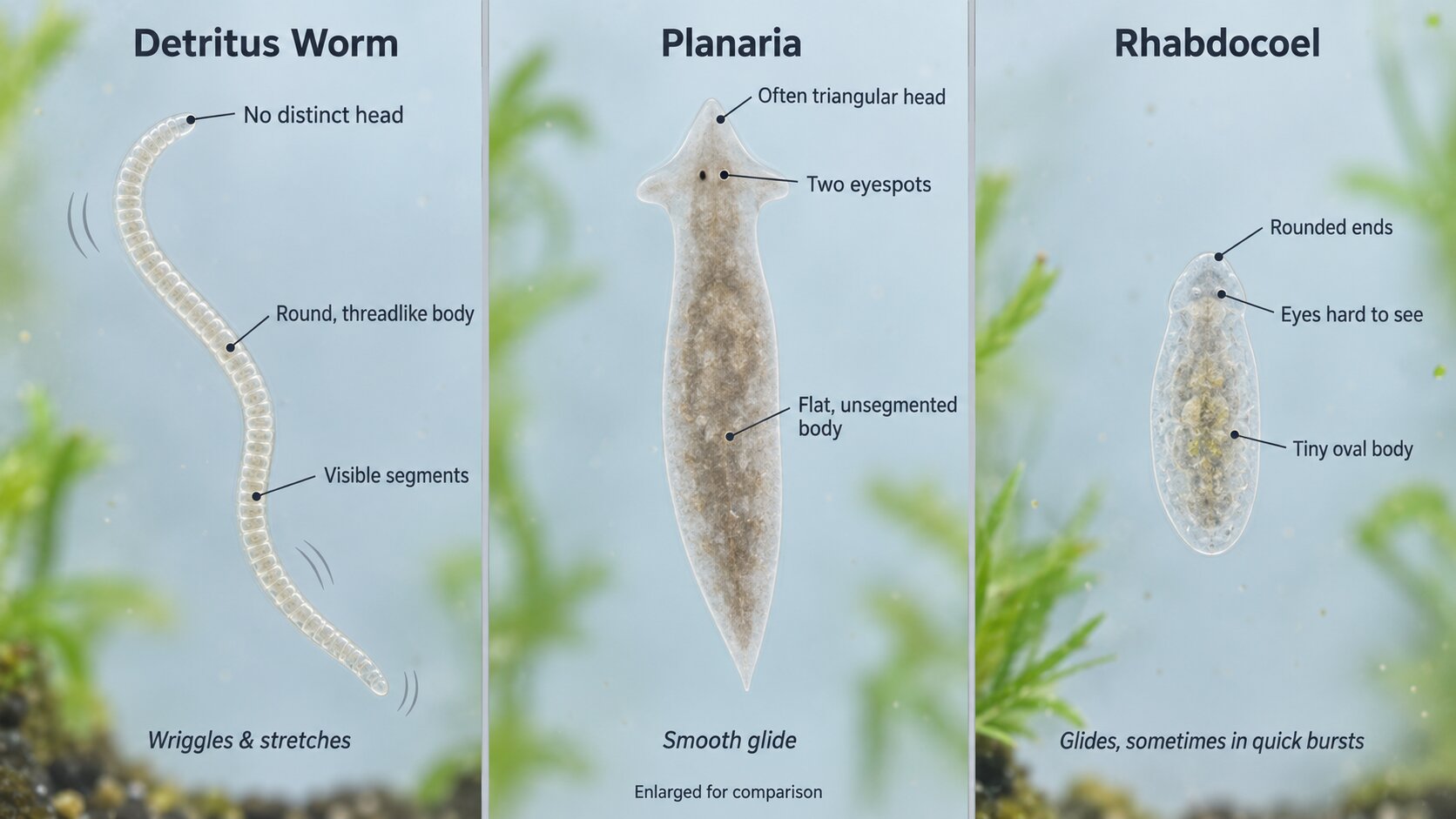
| Feature | Detritus worms | Planaria | Rhabdocoels |
|---|---|---|---|
| Body | Round, segmented | Flat, unsegmented | Flat, unsegmented |
| Head | Usually no obvious distinct head | Often triangular; eyespots common | Often rounded; eyes may be difficult to see |
| Movement | Wriggling, stretching, sometimes swimming | Smooth gliding | Gliding; sometimes quick movements |
| Typical appearance | Thin thread | Flattened worm | Tiny oval or elongated flatworm |
| Feeding | Organic material and microbes | Predators and scavengers | Diverse; some species are predators |
| Concern | Usually low | Depends on livestock | Generally low priority, but risks may be uncertain |
Is a triangular head enough to identify planaria?
No. It’s a useful clue, but not proof.
The shape of a flatworm’s head changes as it contracts and stretches. Some planarians lack an obvious arrowhead, and their eyespots may be invisible without magnification.
A blurry photo can also make the pointed tail look like a head.
If the distinction matters to your livestock, examine the organism more closely before attempting treatment.
When a photograph isn’t enough
Try collecting an individual in a small, clear container.
Place the container against a white background, illuminate it from the side, and observe it with a magnifying glass or macro lens.
Look for segments, eyespots, body shape, and characteristic movement.
A short video showing the organism moving is often more informative than a still image.
If you cannot confidently identify it, don’t assume that treating the entire aquarium is the safest option.
Other common aquarium worms and hitchhikers
Not everything that looks like a worm is actually a worm.
Freshwater aquariums can host tiny crustaceans, insect larvae, freshwater cnidarians, and other organisms.
Here are some of the most common.
Roundworms (nematodes)
Free-living roundworms are commonly associated with substrate, aquatic plants, and organic material.
They have smooth, unsegmented bodies, usually tapered at both ends.
Unlike segmented detritus worms, nematodes often move with a distinctive whip-like or S-shaped thrashing motion.
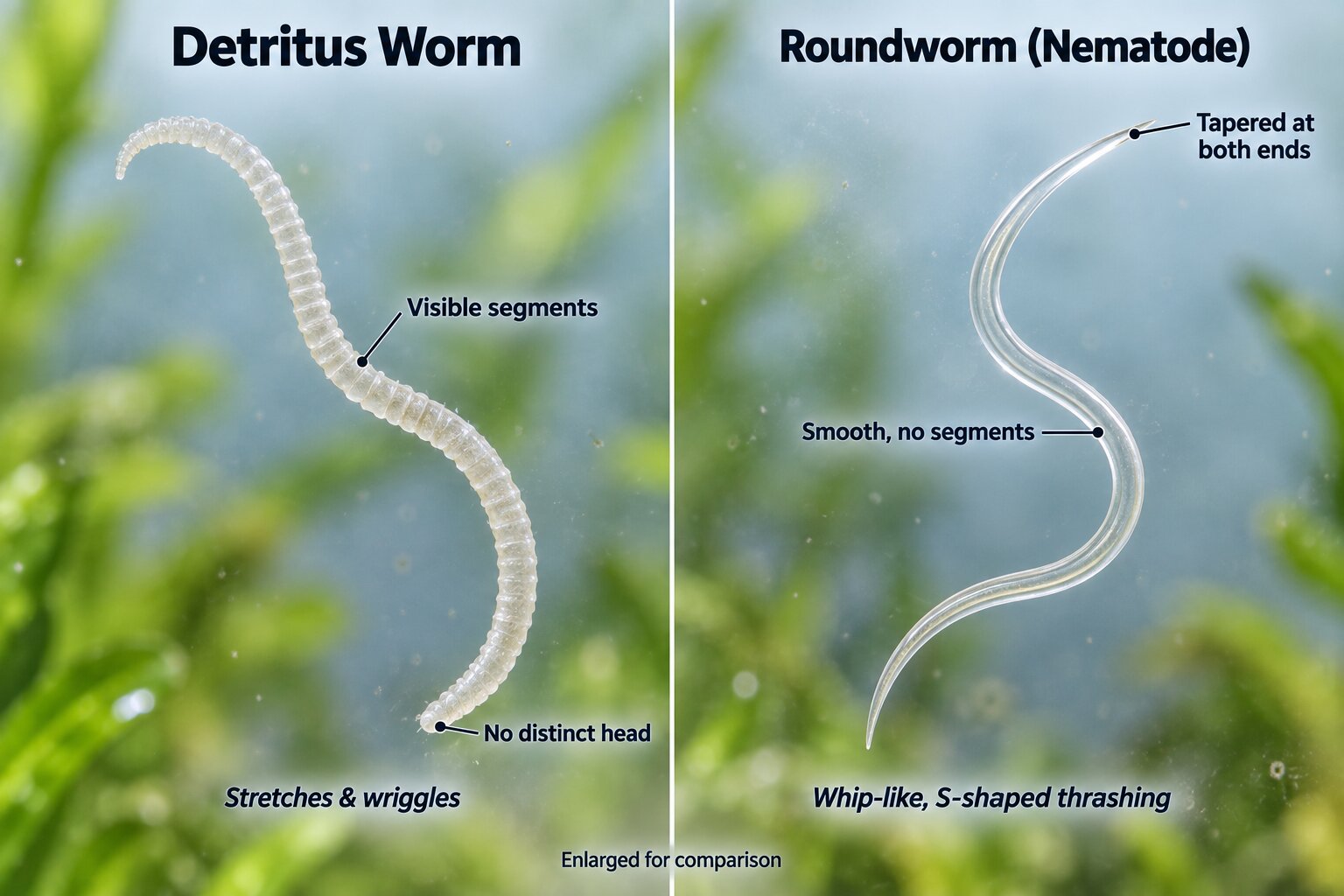
Many free-living species feed on bacteria, fungi, and other microorganisms.
The small, free-living nematodes encountered in aquarium substrate are generally not a concern for healthy livestock.
However, a worm living freely in the substrate is a different identification problem from one emerging from a fish or attached to its body.
If you notice a red thread protruding from a fish’s vent, for example, investigate a possible parasite rather than assuming it’s a harmless detritus worm.
The harmful hitchhikers companion article explains these distinctions.
Hydra
Hydra are tiny freshwater relatives of jellyfish and corals.
They’re not worms.
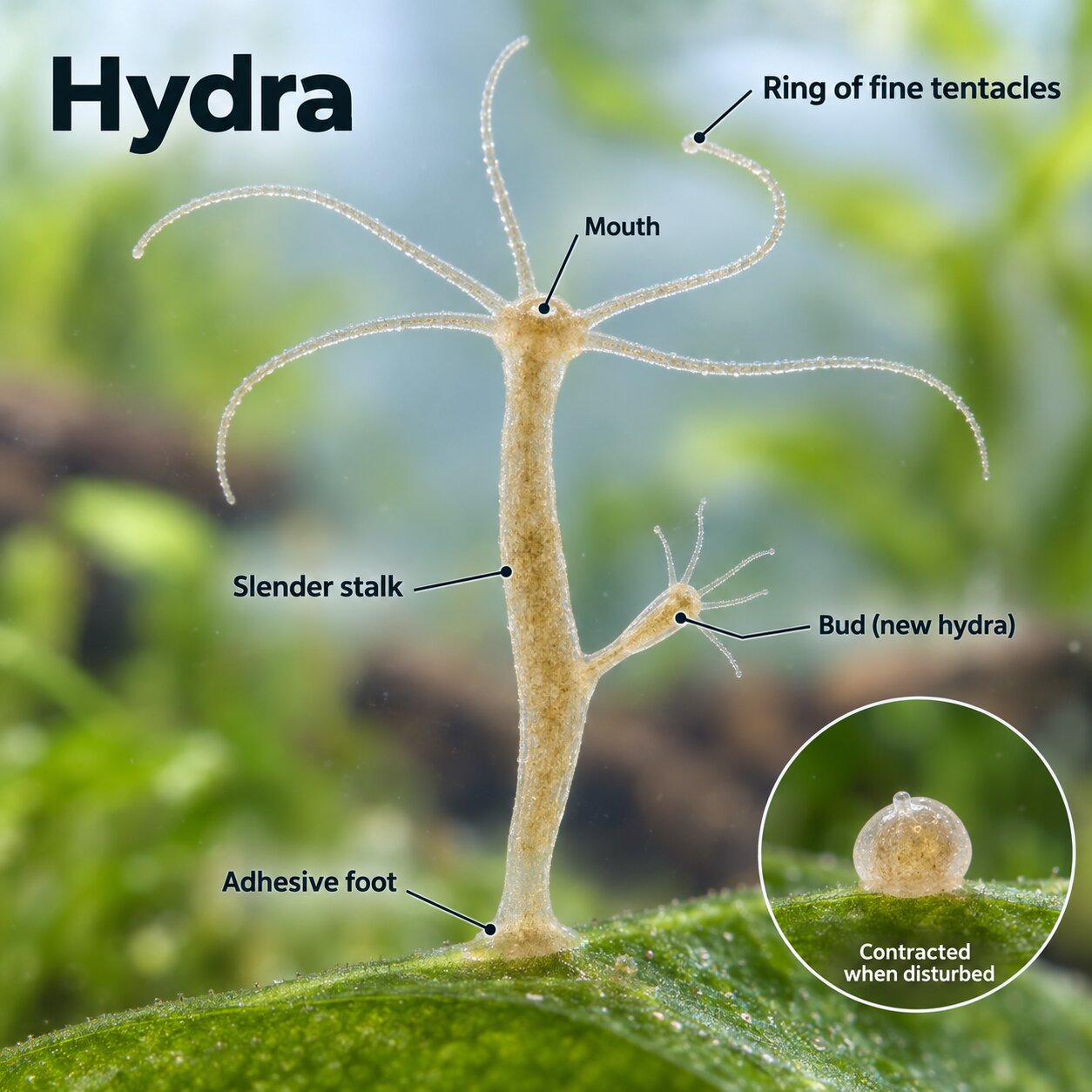
Their bodies resemble little stalks with a ring of fine tentacles surrounding the mouth.
Some are pale, brown, or tan. Green hydra contain symbiotic algae within their tissues.
They usually attach to plants, glass, or decorations using a specialized foot.
When disturbed, they may contract into a tiny blob, making them difficult to recognize.
What they do
Hydra use stinging cells in their tentacles to capture small animals.
Their documented prey includes copepods, water fleas, small insect larvae, and newly hatched fish. They can reproduce by budding, producing new individuals from the sides of their bodies.
Should you worry?
Hydra are not generally a threat to established adult fish.
Their relevance increases in aquariums containing newly hatched fry or other very small animals.
The potential effects on shrimplets require a more careful discussion than simply declaring every hydra an immediate danger.
Our harmful hitchhikers guide examines those risks in detail.
Tiny bugs and crustaceans
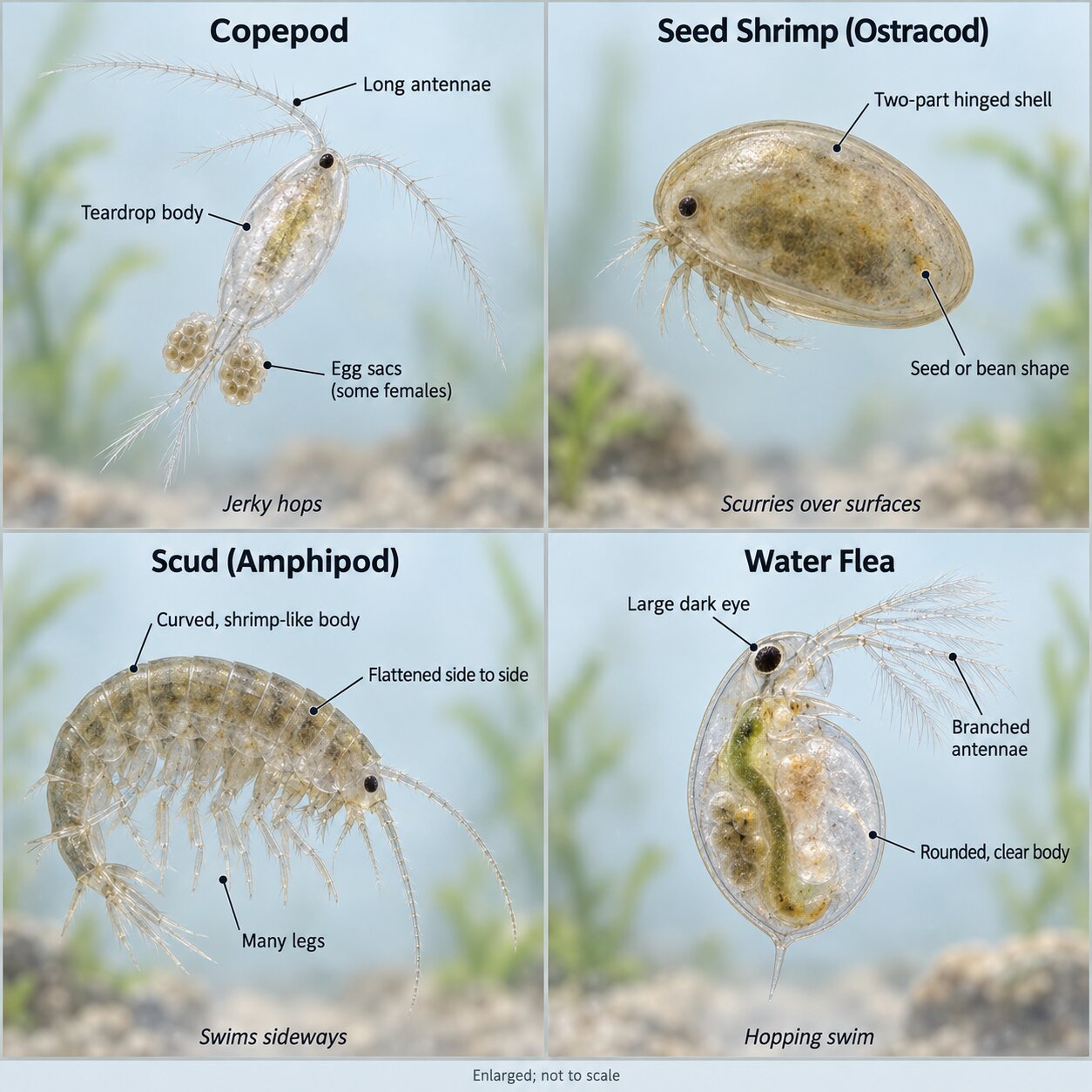
Many of the moving dots on aquarium glass are crustaceans, distant relatives of shrimp and crabs.
Their appearance may be surprising, but they often participate in grazing, decomposition, and the aquarium’s food web.
Copepods
Copepods commonly appear as tiny white or translucent dots, often around a millimeter long.
Some have a teardrop-shaped body, and females of certain species carry conspicuous egg sacs.
Their movement is distinctive: sudden, jerky hops through the water or across surfaces.
Many free-living copepods consume algae, microorganisms, and suspended organic particles. Others are predators.
They also serve as food for many fish.
Should you worry?
Most free-living copepods encountered in established community aquariums require no intervention.
However, not all copepods have the same lifestyle.
Some predatory cyclopoid copepods can capture vulnerable fish larvae. Laboratory research found that susceptibility depended on the fish species, copepod size, and population density.
Parasitic copepods also exist, but those attached to fish are a separate concern from harmless-looking dots swimming freely.
Seed shrimp (ostracods)
Seed shrimp look like tiny moving seeds or beans.
Their bodies sit inside a hinged, two-part shell, giving them an appearance quite different from most other aquarium crustaceans.
They scurry across plants, substrate, and glass, occasionally swimming in short bursts.
Many feed on algae, biofilm, and organic material, although diets vary among species.
Should you worry?
The small grazing ostracods commonly encountered in aquariums are generally low concern.
Their hard shells can make them difficult for some fish to digest.
In one experiment, approximately a quarter of ostracods fed to small sunfish survived passage through the digestive tract. That doesn’t mean all seed shrimp survive being eaten, but it helps explain why some populations persist even when fish consume them.
A large population is a reason to review available food, not automatically a reason to treat the aquarium.
Scuds (amphipods)
Scuds resemble small, curved shrimp.
Their bodies are compressed from side to side, and they often swim sideways or dart through plants.
They frequently hide in moss, leaf litter, substrate, and dense vegetation.
Many are omnivores, consuming decomposing plant material, microorganisms, and other small invertebrates.
Should you worry?
In community aquariums, scuds are often simply another part of the food web.
The situation becomes more complicated in shrimp-breeding tanks.
Shrimp keepers sometimes report competition for food and reduced shrimplet survival when scud populations become dense. However, these observations don’t establish that every scud species preys on young ornamental shrimp.
Different amphipod species have different feeding habits.
Their significance depends on identification, population size, and what you’re trying to maintain in the aquarium.
Water fleas
Water fleas, including Daphnia, are small crustaceans with rounded, often translucent bodies.
They commonly have a conspicuous eye and move with a hopping swimming motion.
They’re more likely to appear after live food or water from outdoor sources has been introduced.
Water fleas are familiar live foods for aquarium fish and are also prey for organisms such as hydra and some flatworms.
They are not normally considered a threat to aquarium livestock.
Leeches
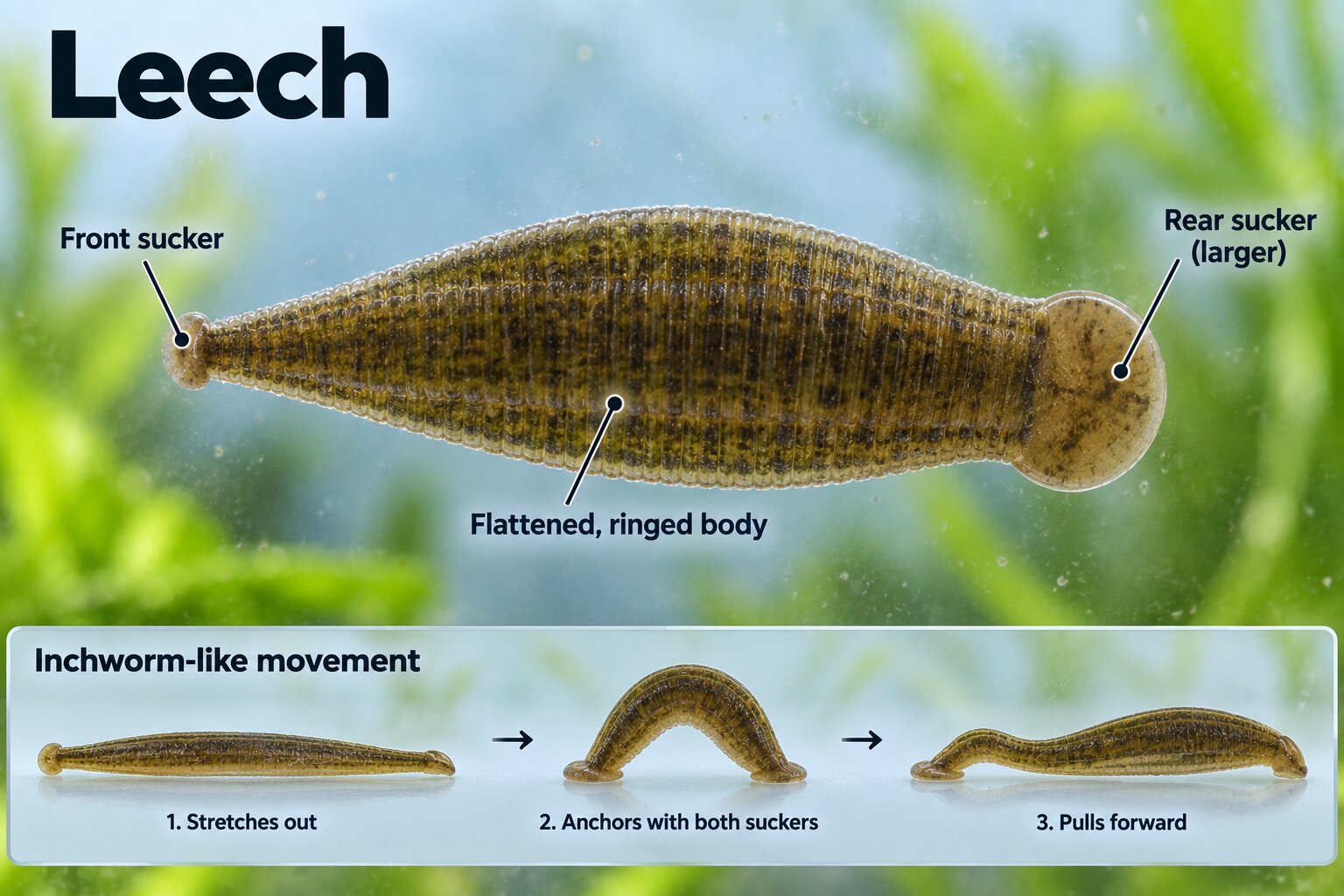
Leeches are segmented worms, but their bodies are usually flattened, and many species possess suckers at both ends.
They may move by repeatedly attaching and releasing their suckers, creating an inchworm-like motion. Some also swim by undulating their bodies.
You’ll find them on plants, glass, decorations, or sometimes attached to snails and fish.
Should you worry?
Leeches cannot all be placed in one category.
Some prey on worms and other small invertebrates. Others feed on snails, while certain species feed on fish blood.
Finding a leech requires identification and an assessment of the animals sharing the aquarium.
For the differences between predatory, snail-feeding, and fish-feeding leeches, see the harmful hitchhikers guide.
Dragonfly and damselfly nymphs
These are immature aquatic insects rather than worms.
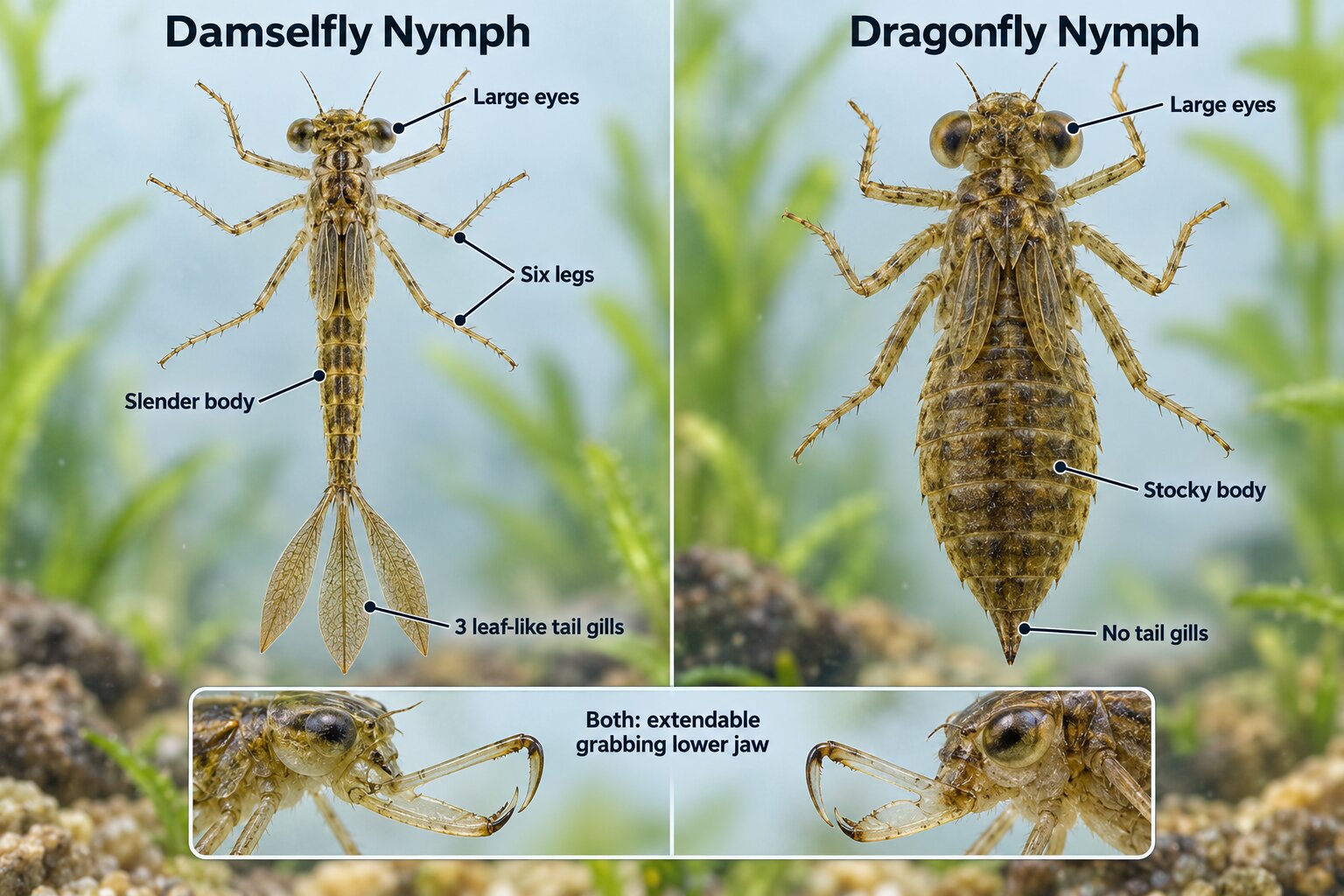
Both have six legs, large eyes, and specialized lower jaws used to grab prey.
Damselfly nymphs generally have slender bodies and three leaf-like gills extending from the rear.
Dragonfly nymphs are usually stockier and lack those external tail gills.
They can arrive on aquatic plants or materials collected from outdoor water.
Should you worry?
Yes, especially in aquariums containing shrimp, fry, or small fish.
These nymphs are active predators capable of capturing other aquatic animals.
If you find one, carefully remove it with a net or suitable container. Inspect the aquarium for additional individuals.
Do not release aquarium organisms into local waterways.
Our harmful hitchhikers guide covers their identification and removal in greater detail.
Other things you might discover
Not every unfamiliar object in an aquarium needs to become a pest investigation.
Tiny snails and freshwater limpets: Small snails frequently arrive on plants. Freshwater limpets have a little cap-shaped shell rather than the familiar coiled shell of many snails.
Clear jelly with tiny dots: Often snail eggs rather than worms or parasites.
White fuzz on driftwood: Newly introduced driftwood frequently develops microbial growth, including bacteria and fungi. This is not the same as a worm infestation.
Something attached to a fish or shrimp: Treat this as a separate identification problem. An organism on an animal can have very different implications from one living freely on the glass.
Wigglers near the surface of an uncovered container: These may be mosquito larvae, especially in outdoor plant-holding containers and quarantine tubs.
If something looks unusual, observe its structure and behavior before assuming what it is.
Are aquarium worms and bugs harmless or harmful?
There isn’t one answer that applies to every organism or every aquarium.
A small predator may have little practical effect on established adult fish but become more relevant in a tank full of newly hatched fry.
Likewise, an organism that coexists with a mature shrimp colony might deserve closer attention when you’re trying to maximize shrimplet survival.
A practical way to approach your findings is to separate them into three groups.
| Generally low concern | Depends on your aquarium | Investigate promptly |
|---|---|---|
| Detritus worms | Planaria | Dragonfly and damselfly nymphs |
| Free-living roundworms | Hydra | Suspected parasites |
| Typical grazing seed shrimp | Scuds | Snail-eating leeches in a snail tank |
| Most free-living copepods | Rhabdocoels | Organisms attached to or protruding from livestock |
| Water fleas | Unidentified leeches | Unidentified organisms associated with injury or illness |
The categories aren’t absolute. Some organisms have many species with different feeding habits, and identification may remain uncertain.
An organism’s size, feeding habits, and access to vulnerable prey are often important factors, but they aren’t the only ones.
For a detailed assessment of individual organisms and the livestock they may affect, continue to Which Aquarium Hitchhikers Are Actually Dangerous?
Why are there suddenly so many worms in my aquarium?
Finding a handful of worms is one thing. Finding dozens crawling across the glass overnight can be surprising.
A sudden increase doesn’t automatically mean your aquarium is dirty.
It may indicate that something has changed in the environment, the population, or the organisms’ behavior.
More food became available
Uneaten fish food, decomposing plant material, and accumulated organic debris can support populations of detritus-feeding organisms.
Predators may also increase when the animals they feed on become more abundant.
Reproduction increased
Some aquarium hitchhikers reproduce rapidly when conditions favor them.
Certain worms can reproduce by fragmentation or other asexual methods. Hydra commonly reproduce by budding, while some flatworms and seed shrimp have reproductive strategies that allow populations to grow under favorable conditions.
The reproductive behavior varies by species.
There are fewer effective predators
An aquarium with adult fish may have different populations of tiny invertebrates from a shrimp-only aquarium.
Dense vegetation, moss, and substrate also provide hiding places where small organisms can persist.
Something new entered the aquarium
Plants, livestock, live food, substrate, and transferred water can introduce organisms that previously weren’t present.
Some may have been there for weeks before becoming noticeable.
You disturbed the substrate
Vacuuming, replanting, or moving decorations may expose animals that normally remain hidden.
This can create the appearance of a sudden population explosion even when the actual population has not changed.
Oxygen availability changed
Some aquatic worms alter their position and movement in response to oxygen conditions.
Tubificid-type worms, for example, may increase tail-waving behavior when surrounding oxygen levels decline.
If large numbers of worms suddenly appear outside the substrate, particularly alongside fish breathing rapidly or gathering near the surface, investigate oxygen availability and water quality promptly.
The takeaway: Overfeeding is one possible explanation, but it isn’t the only one.
Look at the aquarium’s recent history before deciding what the organisms are telling you.
What should you do when you find aquarium worms?
The response should match the identification and the circumstances.
Our approach is straightforward:
Observe → Identify → Assess → Respond.
1. Observe
Watch the organism before disturbing it.
Note its shape, movement, location, and approximate size.
Check whether your fish, shrimp, and snails are behaving normally.
2. Identify
Compare your observations with the identification guide.
Record a video or use magnification if necessary.
Avoid making treatment decisions from an uncertain identification.
3. Assess
Think about the animals in your aquarium.
Are there vulnerable fry, eggs, shrimplets, or snails? Is the organism simply grazing on glass, or is it attached to livestock?
Consider whether the population has changed suddenly.
4. Respond
Match your response to the actual concern.
Harmless free-living organisms may need nothing more than observation and routine maintenance.
Confirmed predators near vulnerable livestock, or suspected parasites, may require targeted removal or further investigation.
Do you need to treat the entire aquarium?
Usually, finding an unfamiliar worm isn’t enough reason to begin chemical treatment.
Treatment should address a confirmed problem, not simply the presence of life you didn’t intentionally introduce.
Some aquarium medications can harm shrimp, snails, other invertebrates, plants, or biological filtration. Copper-based treatments, for example, require careful control and can be highly toxic to invertebrates.
Using a treatment intended for one organism against something you’ve misidentified may create a larger problem than the original discovery.
Start with identification and husbandry.
Review feeding, remove accumulated leftovers, check water quality, and address maintenance issues where appropriate.
Never starve fish or shrimp in an attempt to eliminate hitchhikers.
If a genuinely harmful organism is present, choose a response that accounts for the entire aquarium, not just the organism you’re trying to remove.
Our companion article, How to Prevent and Control Aquarium Hitchhikers Safely, covers manual removal, population management, treatment considerations, and ways to reduce unwanted introductions.
How do aquarium hitchhikers get into a tank?
Even aquariums started with clean equipment and carefully selected livestock can develop populations of unexpected organisms.
Common introduction routes include aquatic plants, fish, shrimp, snails, live foods, transferred water, substrate, and materials collected from other aquatic environments.
An organism might arrive as a visible adult, a tiny juvenile, or an egg that’s nearly impossible to notice.
Some reproduce after entering the aquarium, while others remain hidden until conditions make them easier to see.
Quarantining and inspecting new additions can reduce the risk of introducing unwanted organisms, but no routine guarantees a completely hitchhiker-free aquarium.
The goal is to reduce meaningful risks while maintaining a healthy environment for the animals you intentionally keep.
Our prevention and control companion guide explains how to inspect new plants, manage introductions, and respond when unwanted organisms are discovered.
Frequently asked questions
Are tiny white worms in my fish tank harmful?
Usually, the thin white worms moving freely through the substrate or across aquarium glass are free-living organisms such as detritus worms or nematodes.
These are generally low concern.
Flatworms that glide across surfaces deserve closer identification, particularly in breeding aquariums. A worm attached to or protruding from an animal should be investigated separately.
Can a healthy aquarium have worms and bugs?
Yes.
Small invertebrates are common components of freshwater ecosystems, including home aquariums.
Their presence alone doesn’t prove that an aquarium is healthy or unhealthy.
Water quality, livestock health, population changes, and the type of organism provide more useful information.
Should I remove every organism I didn’t intentionally add?
No.
Many small organisms feed on detritus, algae, microbes, or other tiny animals. Some also become food for fish.
Removing everything unfamiliar is neither necessary nor a realistic goal for a functioning ecosystem.
Focus on organisms that pose a meaningful risk to your livestock.
Will fish eat aquarium worms and bugs?
Many fish consume small invertebrates when they can find and capture them.
However, feeding behavior varies by species, and some organisms remain protected in substrate, moss, or other hiding places.
Adding a fish solely to control hitchhikers can introduce new compatibility and stocking problems.
Choose livestock based on their long-term needs, not as a temporary pest-control solution.
Do aquarium worms mean I’m overfeeding?
Not necessarily.
Extra food can support growing populations, but organisms may also become visible after substrate disturbance, a recent introduction, reproduction, or changes in oxygen availability.
Review feeding and maintenance alongside the aquarium’s recent changes before identifying a cause.
Where do aquarium worms come from if I never added them?
They can enter on plants, animals, substrate, transferred water, and live food.
Some arrive as eggs or tiny juveniles and remain unnoticed until they reproduce or become more visible.
A healthy aquarium doesn’t have to be sterile
Discovering an unfamiliar organism can be unsettling, especially when you’re responsible for the health of your fish, shrimp, and snails.
But not every unexpected inhabitant is an enemy.
Detritus worms help process organic material. Tiny crustaceans graze and become part of the food web. Even organisms that function as predators in natural ecosystems may have little practical effect on some established aquarium communities.
The important distinction is whether their presence creates a meaningful risk for the animals you’re keeping.
Observe what you’ve found. Identify it as accurately as you can. Consider your aquarium’s inhabitants and conditions.
Then respond only as much as the situation requires.
The goal isn’t a sterile aquarium. It’s an ecosystem that remains compatible with the animals you choose to keep.
Continue reading: Aquarium hitchhiker guide series
Which Aquarium Hitchhikers Are Actually Dangerous?
Learn which organisms may threaten fish, shrimp, snails, eggs, and fry, how to recognize warning signs, and when action is necessary.
How to Prevent and Control Aquarium Hitchhikers Safely
Learn how to inspect and quarantine new additions, manage unwanted populations, remove organisms safely, and evaluate treatment risks before introducing chemicals.
The Tank Guide is a FishKeepingLifeCo publication.
Track water parameters, maintenance, and tank changes with our journals and guides.