Buying Shrimp Online: A Documentation of the Process
By FishKeepingLifeCo | Updated January 2026
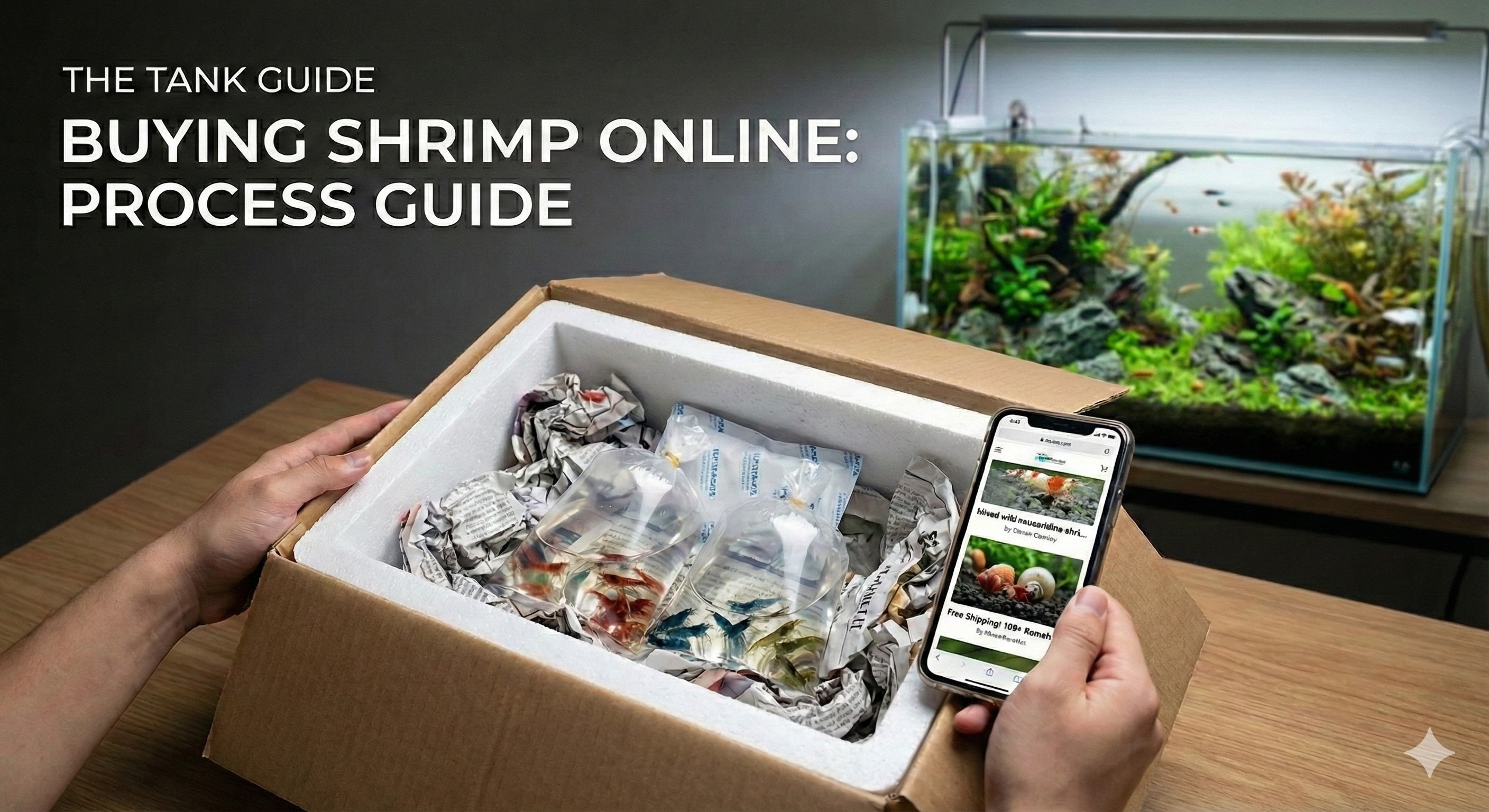
Buying shrimp online has become increasingly common in the aquarium hobby, but the experience is still misunderstood. For many hobbyists, online livestock purchases feel risky, opaque, and overly dependent on reviews that don’t always explain why an order went well—or didn’t.
This article is not an endorsement of any seller or platform.
It is a documentation of the online shrimp-buying experience, using one real purchase as a case study to help hobbyists better understand what the process actually looks like from start to finish.
While this case study uses Aquafindr as the example platform, the principles and process documented here apply to any C2C aquatic marketplace or individual online livestock seller.
Discovery: How Hobbyists Find Livestock Online
Like many aquarists, this started through social media—where algorithms increasingly surface niche hobby sellers and communities that might never appear through traditional forums or local stores.
We’re active on TikTok ourselves and are still learning how its algorithm surfaces creators, sellers, and specialized marketplaces within the hobby. The platform functions less like a social feed and more like a discovery engine, introducing people to products and services they may never encounter otherwise.
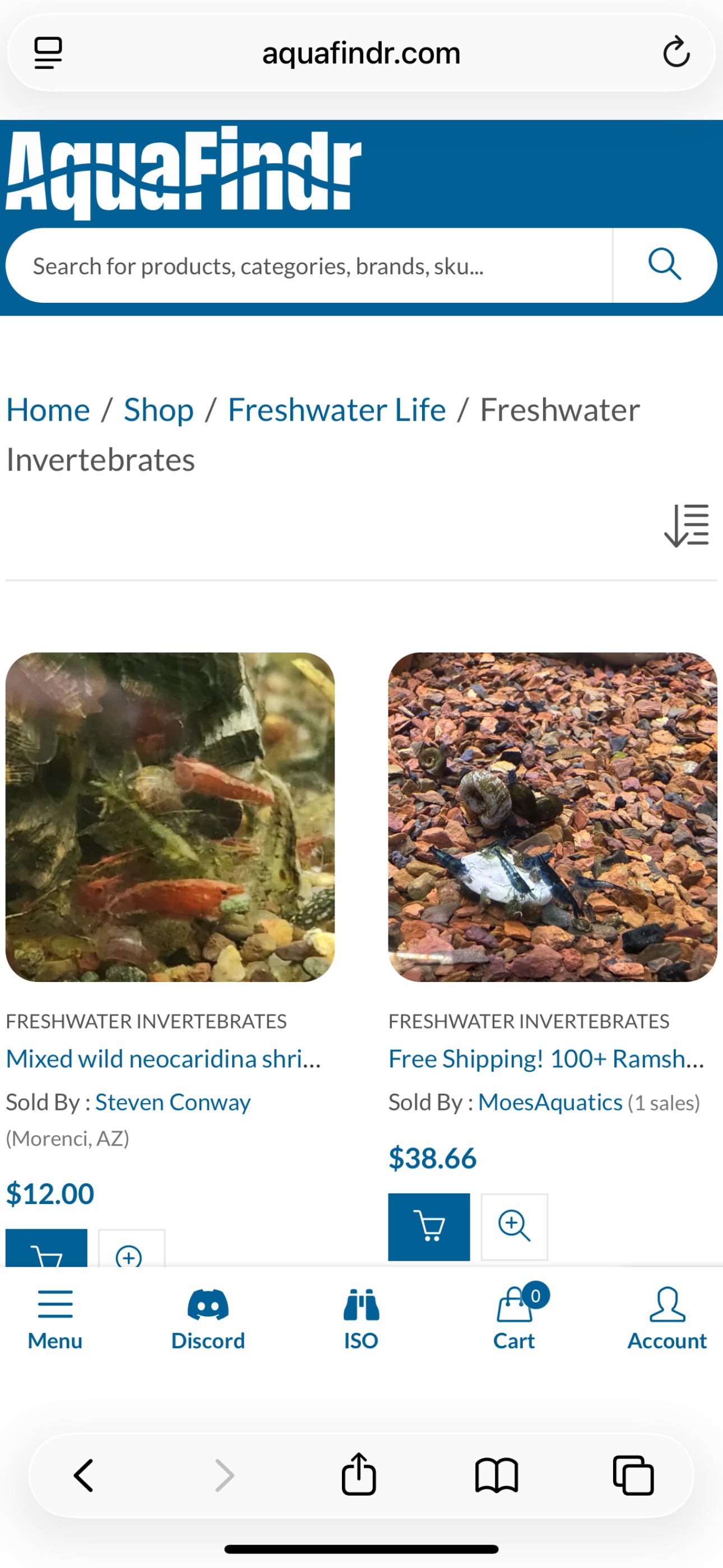
That’s how we came across Aquafindr, which operates as a consumer-to-consumer (C2C) aquatic marketplace, meaning individual hobbyist sellers list livestock rather than a single centralized retailer. This means each seller sets their own shipping schedules, DOA policies (Dead on Arrival policies, which define seller responsibility if livestock doesn’t survive shipping), and communication practices—similar to how individual eBay sellers operate independently.
The Marketplace Concept That Stood Out
What initially caught our attention wasn’t a specific shrimp listing, but the platform structure itself.
Aquafindr presents itself as a dedicated marketplace for the aquarium hobby, similar in structure to eBay, but focused exclusively on aquatic livestock and plants. Instead of navigating dozens of individual seller websites, the idea is to centralize listings in one place while keeping the focus entirely within the hobby.
The appeal was less about seller quality and more about observing how a dedicated aquatics marketplace operates compared to general retail platforms or individual seller websites:
- One platform for livestock and plants
- Multiple sellers in a single marketplace
- Simplified browsing and comparison
- A space built specifically for aquatics, not general retail
This structural model raised questions worth exploring firsthand: How does accountability work across multiple sellers? How transparent are individual seller policies? What does the buyer experience actually look like compared to expectations?
Why We Decided to Place an Order
We decided to document this experience because online livestock purchasing is increasingly common but poorly understood—especially for hobbyists encountering these platforms for the first time.
Rather than speculating about what online shrimp buying might be like, we wanted to experience it directly—from discovery to checkout to delivery—and document the process along the way.
Screenshots and records were kept throughout the experience, not to critique individuals, but to capture what a typical hobbyist might encounter when ordering live shrimp online.
Checkout, Payment, and Communication
Once we decided to move forward, the next phase was the checkout and payment process.
The purchase was made through a centralized marketplace rather than a single-storefront seller. That distinction matters, because it shapes expectations around communication, fulfillment, and responsibility.
The checkout process functioned similarly to other online marketplaces—nothing unusual or confusing about payment mechanics:
- Selecting the listing
- Reviewing quantities and pricing
- Entering shipping and payment information
- Completing the transaction
Payment Protection Matters
Another important part of online livestock buying is how you pay.
We strongly recommend using a payment method that offers buyer protection—such as PayPal—when purchasing live animals online. Most marketplaces allow multiple payment methods at checkout; choosing one with buyer protection ensures you have documented recourse if the shipment arrives with DOA livestock that isn’t covered by the seller’s specific policy.
This isn’t about assuming bad intent; it’s about protecting both sides if something goes wrong during shipping or arrival.
Live animal transactions carry inherent risk, and payment protection provides:
- Documentation of the transaction
- A defined dispute process if needed
- An added layer of accountability for all parties
This is especially important when dealing with individual sellers within a larger marketplace.
Post-Checkout: Confirmation, Communication, and Expectations
After checkout, confirmation came through as expected.
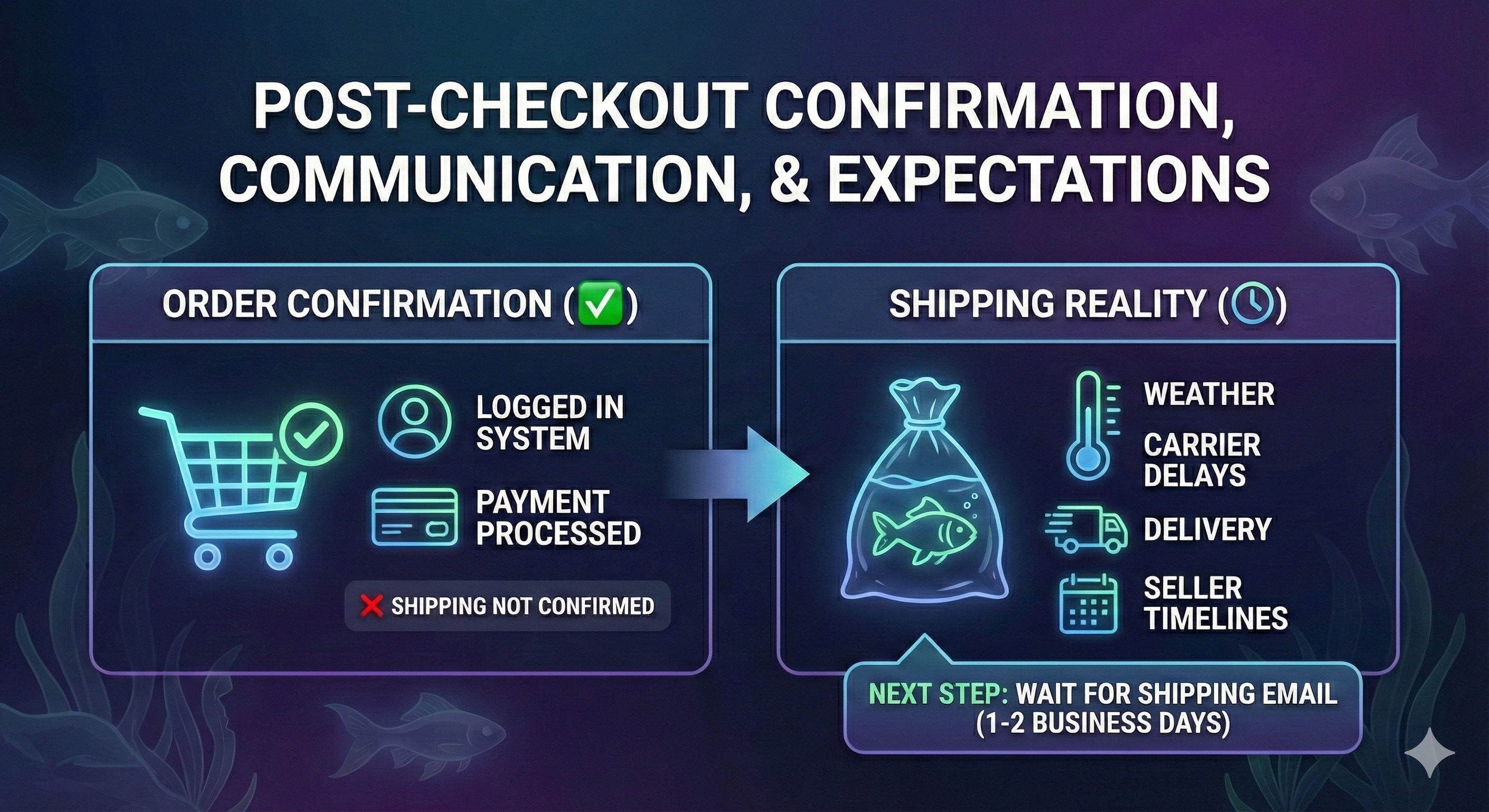
Order confirmation is not shipping confirmation. It establishes the order exists in the system, but shipping timing depends on seller coordination and logistics.
Live aquatic livestock introduces variables that don’t exist with dry goods:
- Weather conditions
- Shipping schedules
- Carrier delays
- Seller handling timelines
Expectation Check: What ‘Order Confirmation’ Actually Means
✅ Your order is logged in the system
✅ Payment has been processed
❌ Shipping is NOT confirmed or scheduled yet
❌ The seller has NOT packaged livestock yet
⏱️ Next step: Wait for shipping confirmation (typically 1-2 business days)
Communication Reality in C2C Marketplaces
One of the biggest differences between buying livestock online and buying equipment is communication—and this is where many first-time buyers feel the most uncertainty.
When purchasing through a marketplace, understand that each seller operates independently. This includes:
- Shipping schedules
- Response times
- DOA policies
There is no single, universal DOA policy that applies to every listing. Buyers are responsible for reviewing the specific seller’s terms before purchasing, especially when ordering live animals.
Unlike ordering dry goods, livestock purchases don’t always generate frequent updates. Periods of silence—especially before shipping—are often normal and simply mean the order hasn’t reached the next step yet.
Silence shouldn’t be indefinite, however. While there’s no universal standard, we recommend expecting communication within two business days as a reasonable baseline for live animal orders. If there has been no update or response after two weekdays, it is appropriate—and recommended—to reach out to the seller directly through the platform.
Clear, professional communication early helps avoid misunderstandings later, especially if shipping schedules or availability change.
While buyers are responsible for understanding seller policies and preparing appropriate conditions, sellers also carry ethical responsibility: shipping only healthy livestock, using appropriate packaging, and communicating delays or issues promptly. Responsible online livestock purchasing requires both sides to prioritize animal welfare over convenience.
Logistics and Welfare: The Science of Shipping Windows
Once shipping entered the picture, the experience shifted from abstract to tangible. This is the point where preparation, patience, and expectations start to matter far more than the platform or the listing itself.
After the order moved forward, shipping information was provided, reflecting coordination between the seller and the carrier. As with most live animal shipments, there was a clear delivery window rather than an exact time.
Shipping is an active stress period layered onto already sensitive animals. Live shrimp shipments are influenced by factors outside anyone’s direct control:
- Carrier routing (the number of transfer points and stops between origin and destination)
- Weather conditions along the route
- Transit time variability
- Seasonal temperature swings
Each of these variables introduces physiological stress: temperature shock, oxygen depletion, and ammonia buildup in sealed bags.
Key Principles of Shrimp Welfare in Transit
Across most responsible online livestock shipments, a few consistent principles apply:
- Minimize total transit time
- Avoid weekend carrier storage
- Reduce temperature fluctuations
- Limit oxygen depletion in sealed bags
These principles shape when and how shrimp are shipped and explain many of the delays or scheduling decisions buyers encounter.
Shipping Timing, Weekends, and Holiday Planning
One detail that often catches first-time buyers off guard is when livestock is actually shipped.
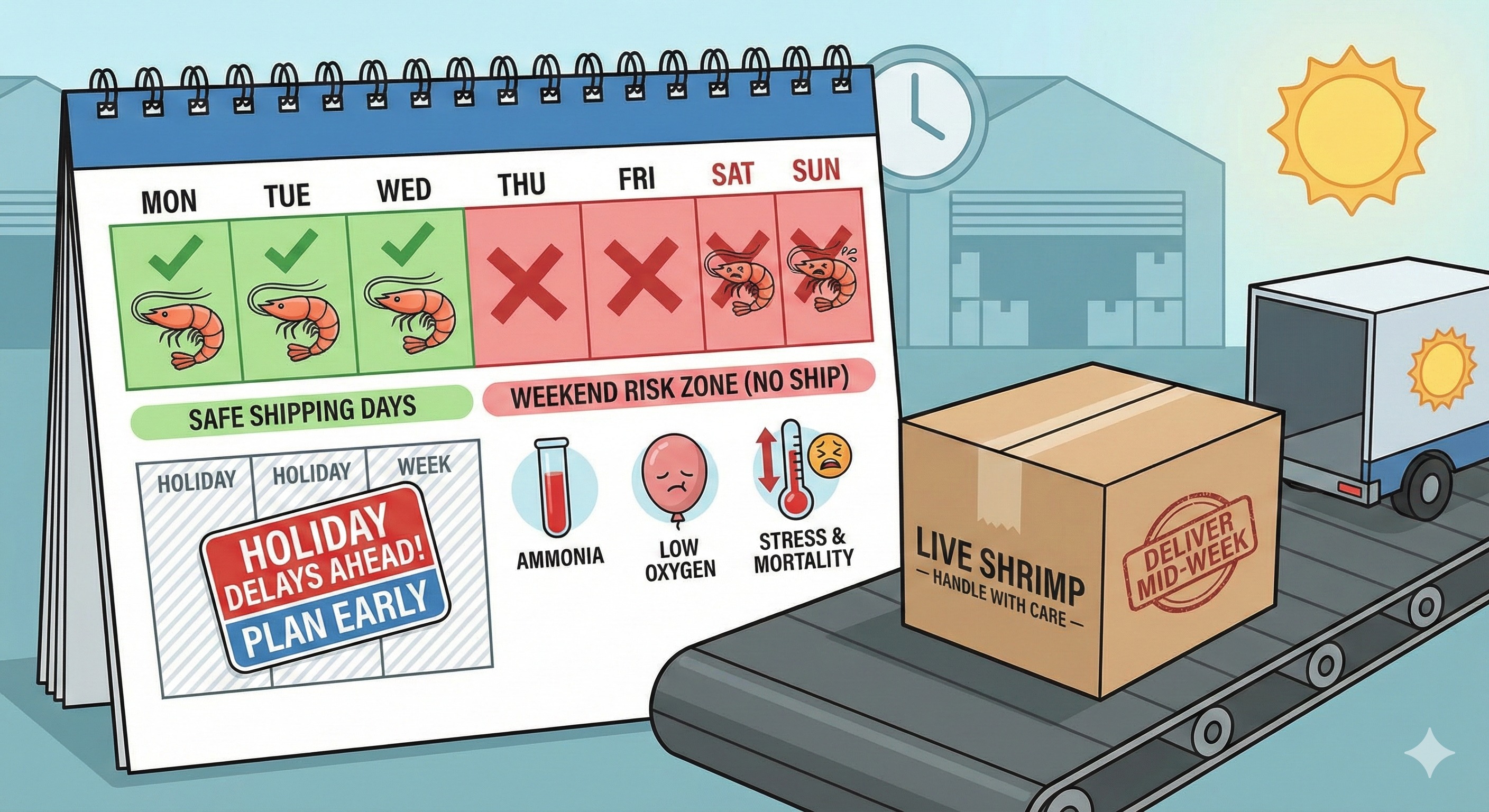
Live shrimp shipments are typically planned so packages move continuously through the carrier system without weekend delays. This is why most reputable sellers won’t ship past Wednesday—it reduces the risk of livestock sitting in a warehouse over the weekend.
Why Sellers Don’t Ship Past Wednesday
Thursday/Friday shipments risk weekend delays, meaning livestock could sit in a carrier facility for 2-3 days without movement. This increases:
- Ammonia buildup in sealed bags
- Oxygen depletion
- Temperature fluctuations
- Overall stress and mortality risk
Responsible sellers plan shipments to arrive mid-week, not mid-crisis.
Holidays add another layer of complexity. Carrier schedules change, transit hubs become congested, and delays are more common. Ordering livestock immediately before or during a holiday period increases risk, even when sellers act responsibly.
Preparation: What Happens Before the Box Arrives
By this point in the process, nothing about online shrimp buying is theoretical anymore—but nothing is physical yet either.
The decisions made before shipping—when to order, how to pay, how to communicate, and whether timing aligns with weather and holidays—have already shaped the outcome long before the package is delivered.
This is where many online livestock purchases quietly succeed or fail. Not because of what happens on delivery day, but because of:
- Whether expectations were realistic
- Whether timing was planned responsibly
- Whether the buyer understood how live animal shipping actually works
Understanding shipping windows, weekend cutoffs, and holiday delays doesn’t just reduce anxiety—it directly improves animal outcomes.
Common Mistake: Ordering Without Readiness
Many first-time online livestock buyers order impulsively, assuming they can “figure it out” after the package arrives. This creates unnecessary stress for both the hobbyist and the animals.Before clicking “checkout,” confirm:
- Tank parameters are stable and species-appropriate
- You’ll be home during the delivery window
- You have an acclimation plan and quarantine option ready
- Local weather won’t create extreme temperature swings during shipping
Impulse purchases—ordering without checking weather forecasts, confirming you’ll be home for delivery, or having a quarantine tank ready—don’t just create logistical problems. They directly increase the likelihood of shrimp arriving to inadequate conditions, even when shipping itself goes perfectly.
Responsible online livestock buying begins before checkout. Before placing any order, confirm: (1) Your tank parameters are stable and suitable for the species, (2) You have a quarantine or acclimation setup ready, (3) You’ll be available during the delivery window to receive and acclimate immediately.
Online shrimp buying rewards preparation far more than impulse.
What Comes Next
At this stage, the order exists. The shipment is planned. Everything that can be done before delivery has been done.
What comes next isn’t about platforms, sellers, or policies—it’s about readiness, observation, and restraint once the box is opened. The next phase covers delivery day realities, acclimation as a critical step, and first impressions versus long-term outcomes.
Because in online shrimp buying, arrival is not the finish line—it’s the handoff.
Frequently Asked Questions
What is a C2C aquatic marketplace?
A C2C (consumer-to-consumer) aquatic marketplace is a platform where individual hobbyists list livestock directly to buyers. Unlike traditional retailers, each seller sets their own shipping schedules, communication practices, and DOA (Dead on Arrival) policies.
Why don't online shrimp sellers ship past Wednesday?
Most reputable sellers avoid shipping late in the week to prevent livestock from sitting in carrier warehouses over the weekend. Shipping early in the week ensures animals move continuously and arrive before the weekend shutdown, reducing stress and mortality risk.
How can I protect my payment when buying live shrimp online?
Always use a payment method that offers buyer protection, such as PayPal. This provides a documented dispute process and an added layer of accountability if the livestock arrives DOA and is not covered by the seller’s specific terms.
What does order confirmation mean for live livestock?
Order confirmation means your payment was processed and the order is logged in the system. It does not mean the livestock has been packaged or shipped. Shipping is often scheduled 1–2 business days later to align with weather conditions and carrier availability.
What should I check before ordering shrimp online?
Before checkout, confirm that your tank parameters are stable and species-appropriate, you will be home during the delivery window, an acclimation or quarantine setup is ready, and local weather will not cause extreme temperature swings during transit.

Log parameters, feeding, and maintenance with our journals and guides.